Monday, October 31, 2016

The Woman On The Beach


As the two pranksters are hauled aboard one of the spotter boats, Hooper checks in with Brody on the walkie talkie. Right after his line (‘Did everybody get out of the water all right?’) there is a cut to a young woman on the beach. The sea is on the left of the frame, the land on the right, in a reverse composition of earlier shots. The sand is strewn with pebbles and clumps of seaweed (like the one that the first victim’s severed arm was discovered in). The beach is clearly less attractive to tourists, only a few of whom can be seen in the background. In the centre of the frame there is an artist’s easel, at which the woman has been painting. It makes perfect sense that she should be the one to see the shark, as her eye has been trained on the sea in an attempt to capture it on canvas.As she moves closer towards us, a look of disbelieving horror forming on her face, we get a reverse shot of the mouth of the pond. We can see the crowd of bathers on the other side of the causeway, and the green-roofed bandstand provides a further point of reference to give us our bearings. The woman steps into the frame, obscuring a couple of kids wrapped in yellow towels sitting on the rocks. The colour subliminally alerts us to the approaching danger, just as the first growling notes of the score tell us that what we are looking at over the woman’s shoulder is our first recognisable glimpse of the shark: a large dorsal fin and the smaller tip of a tail moving through the water. Over the beach PA system we hear a man informing the bathers that the earlier sighting was a practical joke. There is a cut to a lower angle of the woman in profile as she gives a name to the threat in a stuttering scream of the single word, ‘Sh- shark!’  

Saturday, October 1, 2016

F For Fake


The panicked bathers are aided at the water’s edge by first responders, dressed all in white like the faithful at a mass baptism. As the camera follows a young boy with a raft running up the beach, it latches onto the mayor who has a look of desperation on his face. He is on the far left of the frame, the same position he occupied within the image at the beginning of the scene. Another shot shows Brody almost obscured by the crowd and then pans to the left to pick out a distraught Ellen calling her son’s name. The next shot is of water, with a strip of land in the background. The fin comes into frame from the right, and upends to reveal itself as a fake, propelled from below by two young boys in wet suits. They remove their snorkels and turn to face the camera as a crackling radio message alerts them to the presence of the spotter boats. A low shot of one of the boats from the boys’ POV has us looking directly into the barrels of half a dozen rifles.


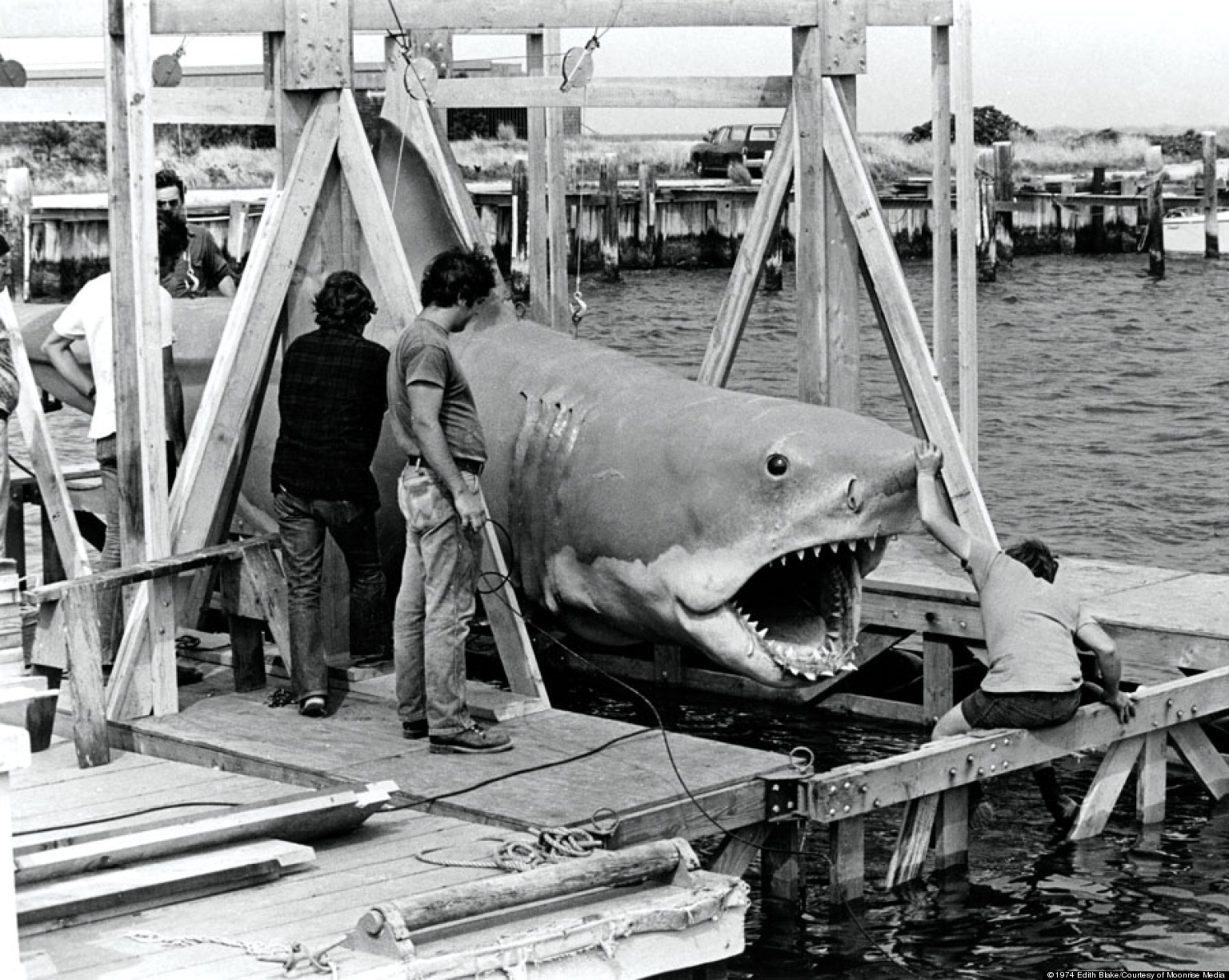
As the men lower their guns, the younger boy raises an accusatory arm above the water and points at his friend, spluttering, ‘He made me do it. He talked me into it.’ It’s a moment clearly designed to get a laugh and release tension. More than a simple practical joke, the fake fin can also be interpreted as a hoax on a meta-level. Despite the filmmakers’ best attempts to downplay the role of the mechanical shark in the pre-release publicity, the audiences back in 1975 went into the movie knowing all about it. As Carl Gottlieb documents in The Jaws Log, the shark was regularly papped during the shooting, often in unflattering positions. So, maybe, in giving us our first glimpse of a fin that turns out to be fake Spielberg is having a joke at our expense, calling out the doubters in the audience, who are always quick to point out a movie’s flaws.

Saturday, May 21, 2016

Panic On The Fourth Of July


It is the shark spotter with the white sun visor who first raises the alarm. (“Jesus Christ! Fin! Shark! Three five zero!”) Behind him on the boat are three other men, two with binoculars looking to the port and to the starboard and one resting the butt of his rifle on his hip. The camera pans swiftly right to left as one of the men races to the bow of the boat and point his glasses in the direction indicated. In the background we can see Hooper’s boat and there is a cut to a brief shot of him giving orders on the walkie talkie (“Red one! Red one! Martin! Get the people out of the water!). 


The shot places Hooper behind the raised windscreen of the boat, with part of the steel frame bisecting the screen almost diagonally. It’s another example of the film’s visual motif of fences and barriers, and could also be seen as a foreshadowing of Hooper’s confrontation with the shark when he will be enclosed in the shark cage. There is a cut to a shot of Brody in front of the bandstand as he turns and looks towards the sea as the radio crackles in his hand.We then get a view of the ocean from the vantage point of one of the raised lifeguard stations, and there is a cut to a close up of the lifeguard rising up into the frame, his hands cupped around his mouth to amplify the sound of the whistle he is blowing on. Behind him we can see a number of sunbathers sprawled on the sand and dozing in the sun. The next brief shot shows a group of fully clothed tourists seated all in a row like movie goers. As one, they raise their own binoculars to get a better view of the carnage to come.

Brody races to the foot of the lifeguard station in an attempt to contain the situation, trying the stop the shrill whistling – the very sound that signalled the beginning of the shark problem when Hendricks found the remains of the first victim on the beach. Brody’s pleas are in vain and he becomes just another helpless observer. After we get a shot from ground level of the lifeguard issuing commands through a megaphone, there is a medium shot of Brody looking in despair to the right of the frame. He then takes a step towards the camera, as if about to make a decision, but then just stops and stares. 


The next shot – which we can assume is from Brody’s point of view – is of people swimming directly towards the camera, whilst in the background the boats are gathering to form a barrier. There follows a series of shots of bathers scrambling for the safety of shore.With the exception of the elderly selectman’s wife, who we see in close up, those in jeopardy remain anonymous. The camera picks out a few individuals – a child on a yellow raft crying as swimmers plough past him; a man who (in a typical disaster movie trope) pushes two children off a raft to commandeer it and save himself; a woman clutching a child protectively to her chest and screaming; an old man trampled in the surf – but the audience has no real investment in their survival. The panic on the fourth of July is a scene of mass rout. 


The concept of group jeopardy was integral to the disaster film and it determined the episodic narrative nature of the genre. Typically, multiple characters would be established in the first act (before the disaster struck) and their developing storylines would alternate in between action set pieces. Along the way some would persevere and some would perish, each character’s chances of survival being inextricably linked to the actor’s status on the call sheet. The casting of well known faces (be they movie stars, character actors, old time Hollywood legends, or TV stalwarts) meant that it was easy for the audience to recognise the characters amidst the mayhem. Had Jaws adopted the disaster movie template then Amity’s beaches might have been populated with the likes of George Kennedy, Shelley Winters, Roddy McDowall and Ava Gardner. Benchley’s novel contained enough soap-opera plot themes (infidelity, blackmail, alcoholism) that could easily have been worked up into multiple storylines, but, in fact, it was this Peyton Place element of the source material that Spielberg rejected from the beginning.

Monday, May 16, 2016

Red Herring


The composition of a brief shot from on board one of the boats has a Cubist-like abstraction: whether by accident or design, it is as if the image has been deconstructed into a series of triangles. On the right of the frame is the blurred profile of a shark spotter, his white sun visor forming a distinctive three-sided shape. The bow of the boat is cropped by the lower right hand side of the frame so that it appears as a shadowy triangle, its hypotenuse running parallel to the slightly curving rail of the craft. A triangular wedge of water is framed between the boat rail and the profile of the shark spotter. As the boat drifts to the right we can see a cluster of beach cabins, their pointed roofs flattened into triangles by the distance. Amidst this arrangement of three-sided forms we briefly glimpse another, a black triangle moving through the water.


Other than the absence of music (which has signalled the approach of the shark up to this point), there is nothing to discourage the viewer from interpreting what they see on the surface as an emblem of the predator below. The fin glides past two young women, who are playfully splashing each other and oblivious to its presence. The camera is raised slightly above the water line to provide a clear view of the fin, which moves smoothly through the water. There is a cut to a woman staring directly into the camera lens, her eyes widening in terror. She screams, turns and makes a panicked scramble towards shore. The same shot with the same reaction is repeated with a male bather. Both shots break the fourth wall by having characters look directly into the camera, essentially directing their gaze at the viewer. 


In his Bloomsbury pocket movie guide to the film Nigel Andrews criticised these ‘straight-to-camera grimaces’ as flaws that in his view make the Fourth of July scene a failure. In her BFI analysis Antonia Quirke reveals that the children on the raft in the background of both shots are the same. However, rather than seeing these examples of mismatched continuity as blemishes, she argues that the assembly of shots was a deliberate choice by the director, and that it sets up the subsequent scene of mass panic as a parody of the disaster movie trope. Essentially, Andrews is arguing that the scene fails to convince because – like the shark fin – the reactions are fake (‘from a 1950s sci-fi cheapie’) and therefore incapable of involving the viewer in the drama. Quirke, on the other hand, gives the director the benefit of the doubt, and takes the view that Spielberg is hoaxing the crowd, just like the two kids with the cardboard fin. The whole scene is not about a great white, but a red herring.

Sunday, April 17, 2016

Predator


The mayor gives an interview for the TV, directing his gaze to the off-screen reporter, whilst in the background Meadows vainly tries to prevent people from waving and mugging into the camera lens. Vaughn’s statement is succinct and to the point (‘I’m pleased and happy to repeat the news that we have caught and killed a large predator that supposedly injured some bathers.’) The twin use of adjectives (pleased and happy) and verbs (caught and killed) employs the politician’s favourite technique of repetition to make a point, giving the sentence a persuasive rhythm. And yet the directness of the language in the first half of the sentence is at odds with the equivocal phrasing of the final clause, pointing up the absurdity of the mayor’s position. There is an infintesimal pause before Vaughn pronounces the word predator, as if he is self-censoring himself by avoiding the use of the word shark. The scene was clearly filmed on one of the less sunny days and it’s a happy coincidence of poor continuity that the greyish sky seems to be offering up yet another contradiction as Vaughn insists that ‘it’s a beautiful day.’ Being a politician, the mayor ends the interview with a soundbite (‘Amity, as you know, means friendship.’), which includes a sly meta-reference to the fact that the man holding the microphone is the creator of the fictional community. There are two real life communities called Amity in the state of New York, either of which may have provided Peter Benchley with inspiration. In his novel, he makes no direct reference to the meaning of the name, but the irony was no doubt intended. 

Saturday, April 16, 2016

Splash


As Michael Brody and his friends carry the boat along the edge of the pond towards the bridge, little Sean Brody, who has slipped under his mother’s radar, runs after them. There follows a series of shots of bathers (both tourists and locals) filmed from just above the water line, accompanied by a soundtrack of children’s shouts, laughter and vigorous splashing. We then cut to a silent underwater shot, showing the bathers from beneath. Their exposed white limbs scissor and kick as the camera comes in close. This is the first underwater shot of the film that does not represent the POV of the shark, which is something the viewer intuitively grasps due to the absence of any music on the soundtrack. 


A cut to one of the spotter boats shows Hendricks raising a pair of binoculars and reporting a possible sighting (‘Thought I saw a shadow.”) on his walkie-talkie. There is a brief shot of Brody on the beach, somewhat sidelined from the main activity, fiddling with the dials of his own radio, before we cut back to Hendricks from a different angle. The shot frames the deputy on the right of the screen, an expanse of water on the left with the the sun shining on it. He lowers the binoculars and delivers his line (‘False alarm. Must be this glare’) It’s a moment that is lifted directly from the novel, but, with its need for narrative efficiency, the film script reduces half a page of dialogue (page 179 of the Fawcett paperback edition) into two terse lines.

There is a cut to another shot of bathers. The water laps against the bottom half of the screen as the camera tracks from left to right, and whenever it submerges the sound cuts out completely. It’s a deliberately disorientating effect, rather like (though less sustained than) the one achieved by Kubrick in The Shining when Danny rides his tricycle across alternating surfaces of carpet and bare flooring.

Sunday, March 13, 2016

The Real Thing


As Brody walks down to the surf there is a cut to a shot of his wife by the soda stand further up the beach. She spies her husband in the crowd and waves to catch his attention. The shot is carefully composed to place Ellen between two iconic American symbols: a Coca Cola sign on the left of the screen, and the stars and stripes fluttering in the background on the right. Taken out of context the image could easily be used as a piece of advertising copy. Indeed, the prominent placing of the red Coke button was no accident, but an example of product placement. In the earlier beach scene when Brody was watching for the shark, drinks coolers with the Coke logo on them had been carefully placed in the background to be clearly visible, alongside some artfully arranged cans of Tab and Fanta from the same company. Compared to the more blatant advertising practices of modern Hollywood, the placement in Jaws was subtly done, and it could even be argued that the colour – like that of the hapless estuary victim’s rowboat – contributes to the foreshadowing of the bloody stain that will spread on the surface of the pond. Other real-life products were also featured in the movie: on board the Orca Brody masks the smell of the chum bucket with Old Spice aftershave, and in his demonstration of machismo Quint crushes a Narragansett beer can.