Friday, October 14, 2011

Summertime Blues


Just as Brody asks Cassidy 'You here for the summer?' there is a series of blasts on a whistle from along the beach and the two men start to run towards the sound. Later during the Fourth of July panic scene Brody will vainly try to prevent the lifeguards from raising a similar warning signal ('No whistles! No whistles!'). It's appropriate that the first note of alarm should be cued up by a word that carries specific associations for the community. Its totemic value has already been established by a number of glancing references in the script, but its full symbolic significance will be distilled in Larry Vaughn's economic equation ('Amity is a summer town. We need summer dollars.')

If summer means economic prosperity, then winter - as Quint's reference to welfare in his town hall speech makes clear - is a period of potential recession. The residents of Amity are acutely aware that 'summer's lease hath all too short a date'. Indeed, so valuable are those few income-generating months that time itself becomes a commodity on the island. 'Twenty four hours is like three weeks,' complains the shrewish motel owner when Larry Vaughn announces the temporary beach closure. When trying to negotiate further beach closures, Brody himself will use time as a bargaining chip ('If we make an effort today, we might be able to save August.'). In the hospital scene Vaughn himself will repeat the same month like a desperate mantra of survival until Brody bluntly states, 'Larry, the summer is over.'

Wednesday, October 12, 2011

What's The Angle?

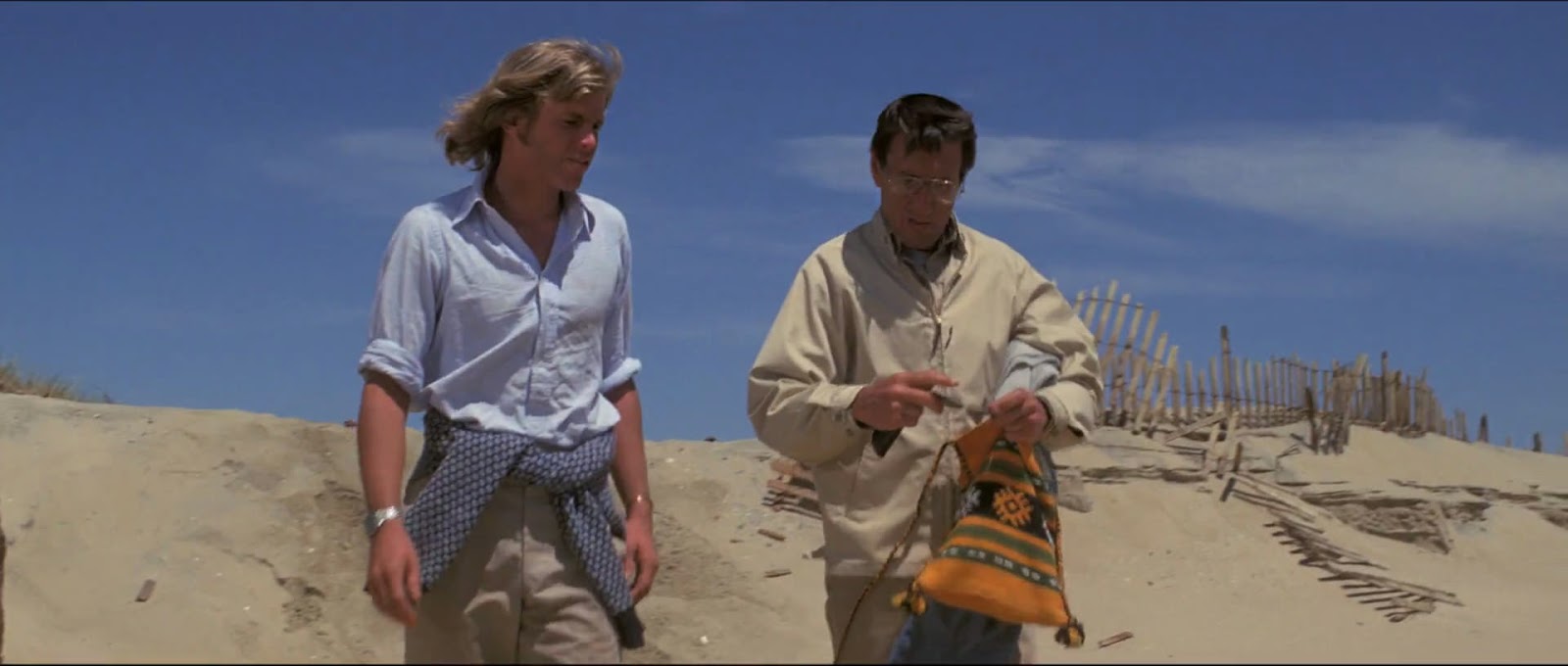
As Brody and Cassidy walk along the top of the dune, the camera - tilted to capture the blue sky streaked with cirrus clouds in the upper half of the frame - tracks along the beach at the base of the slope. Brody carries items of the missing girl's clothing together with an orange hemp handbag with an Inca-type sun motif on it (echoing the sun image on the billboard), and fiddles with a pair of aviator sunglasses. Cassidy, his sweater tied around his waist, holds a length of driftwood in his hands. As they come to the end of the twisted broken fencing and descend the slope onto the beach, each actor executes a small piece of physical business. Brody, testing his shades against the glare of the sun, loses his footing and stumbles. Cassidy, stung by the suggestion that his girl ran out on him, snaps the driftwood in two to punctuate his petulant delivery of the line, 'Look, I reported it to you, didn't I?' Brody's misstep is one of a number of instances that suggest a certain physical clumsiness in the character - later in the hardware store, he knocks over a jar of paint brushes and walking down the corridor to the council chambers he bumps his head against a hanging door sign.


The part of Cassidy was played by Jonathan Filley and it is his only credited role as an actor. He would go on to have a movie career, but as a production manager, not a performer. It was probably a wise choice: the way he snaps the piece of driftwood feels like something done on cue rather than a genuine moment, and, moments later, when called upon to react at the discovery of the girl's remains, he looks frantically about him in an almost pantomime gesture. To be fair, he looks right for the part and his delivery of the line 'I was sort of passed out' carries the appropriate tone of self-centered indifference.

As the two men descend the dune and begin to walk along the beach, the camera swivels round to follow them and then continues to track along the sand with the sea sparkling in the background. Shooting the scene would have required extensive laying of tracks for the camera to run on (this was before the days of the Panaglide camera) and thorough rehearsal of the actors to make sure they hit their marks. Maybe that explains why Filley's snapping of the stick seems slightly wooden - he and Scheider had probably run through the scene countless times to get it right.

Possibly every Spielberg film contains a scene like this - one that involves a single shot, a roving camera and carefully choreographed actors. Orson Welles was a master of this technique, which dispenses with the need for editing whilst retaining a visual dynamic within the frame, and the low angled shot Spielberg uses here is somewhat reminiscent - though not quite as drastic - as those Welles employed in Citizen Kane.

The brief exchange between Brody and Cassidy about their origins ('You an islander?' 'No, New York City.') is the first reference to the notion (already hinted at by the wording of the welcome on the billboard) that Amity is a community unto itself. As one of the residents later says, 'You're not born here, you're not an islander.'

Tuesday, October 11, 2011

It's About Time

As Brody's jeep travels along an empty road, the camera follows it with a pan shot from right to left. The radio is tuned to the local station and as the police vehicle sweeps past there are snatches of the same peppy DJ's voice heard earlier in the bedroom scene. The camera halts on a low-angled shot of a cinema-screen-sized advertisement welcoming tourists to Amity and announcing the island's fiftieth annual regatta. The regatta, incidentally, never makes an appearance in the film, although sailboats featured prominently in the sequel.


The image on the billboard is of a tanned girl in an orange bikini splashing about on a yellow sun lounger. Like Chrissie Watkins, she has long hair and seems to have drifted too far from shore. She looks directly out of the picture, laughing invitingly at the viewer. Two sailboats drift in the background between her and the distant shoreline. In the  top left hand corner of the picture a cartoon yellow sun wearing orange-tinted glasses smiles benignly down. The picture has a frame in the same shade of primrose as the Brodys' kitchen.

The billboard provides us with information about time and place, just as the sliding graphics of Psycho anchor the opening of that picture to a precise moment and location. Amity's regatta is due to start on the fourth of July, a resonant date in the American calendar and one around which the action of the film pivots. The image also tells us that the community is dependent on its summer visitors whilst the wording of this public service message ('Amity Island Welcomes You') emphasises the group over the individual.

Interestingly, the narratives of both Jaws and Psycho take place over more or less the same compressed time period of just over a week. Psycho starts on a Friday (11th December) and ends nine days later on a Sunday (20th December) whilst Jaws starts on a Friday (27th June) and ends eleven days later on a Tuesday (8th July). Both films actually play fast and loose with their own time frames. In the penultimate scene of Psycho a wall calendar clearly displays the day's date as the seventeenth, and - with the exception of the Christmas decorations in downtown Arizona in some early plate shots - there is no reference made to the imminent holiday. In fact, the only reason Hitchcock put the date at the start of the picture was to explain away the presence of those street decorations, which had already been put up when the second unit crew filmed background for the studio process shots in December 1959. It would have been too costly to go back and reshoot them in January and it was too late the dress the Bates motel with fairy lights and a Christmas tree (a trick missed by Gus Van Sant in his spooky shot-for-shot remake).


There are a few wormholes in the time scheme of Jaws, as well. According to the report Brody types up, the first attack takes place on the first of July, whilst the second one takes place on Sunday June 29th - a circumstance made doubly impossible by the fact that that date fell on a Saturday in 1974. By the end of the picture any pretence at accuracy is abandoned when Hooper is unable to name the day of the week ('It's Wednesday. It's Tuesday, I think.'). None of this, of course, has any underlying thematic significance although it probably reflects the sense of dislocation experienced by the film cast and crew as weeks of location shooting on Martha's Vinyard stretched into months, and the concept of time began to lose all meaning.
Monday, October 10, 2011

Exterior Day

 
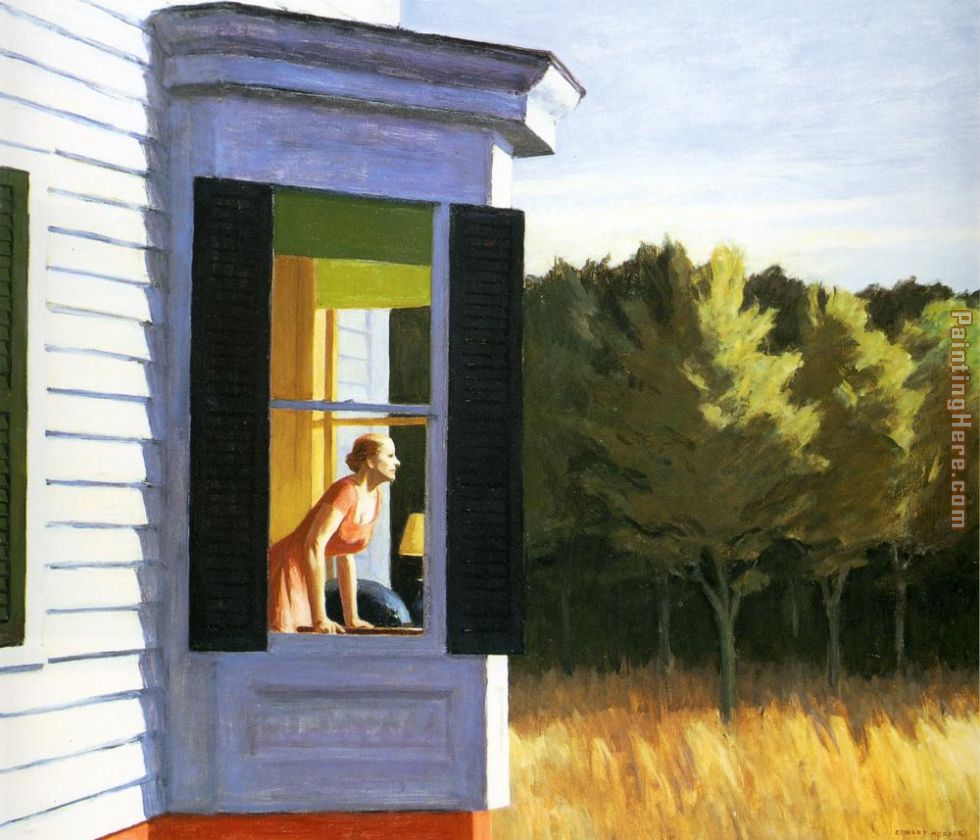
The next shot is of the exterior of a white clapboard house in morning sunlight. There is a softness to the quality of the light that is reminiscent of the Cape Cod paintings of Edward Hopper. A tall fence runs from the right of the frame up to the rear porch steps. In fact, it is hardly a fence at all as there are gaps in it big enough to drive a station wagon through. The door opens and first Michael Brody and then his parents emerge. The boy is wearing swimming trunks and carries flippers and a face mask. He scampers down the steps and runs along the side of the house towards the ocean, which can be seen glittering in the background, a single sailboat on the horizon. Brody - now dressed in full uniform - is carrying a coffee mug, and his wife - still in her pale blue nightdress - follows him, tugging at the towel which still hangs around his neck. They execute a kind of dance as they cross the back yard, Brody obligingly turning in a circle to allow his wife to unravel the towel. This moment of choreography suggests the harmony of their relationship, but logically it makes no sense. In the previous scene Brody, still only half dressed, was wearing the towel around his neck, and it's still there when he emerges from the back door. Didn't he think to remove it when he was putting his shirt on?


The exchange between husband and wife is once again playful ('Listen, chief, be careful, will you' 'In this town?') with Ellen following in the tradition of the typical  Hawksian heroine by calling Brody by the name of his office. As he climbs into his jeep (framed through another open doorway) Ellen climbs onto the swing where her younger son Sean is still playing. The swing - branded a death trap only seconds ago - has now become a convenient prop for providing a mother and child moment. They wave goodbye and, as Brody reverses out into the road, there is a cut to a wider shot of the house (another Hopperesque image) which places it in the coastal landscape.

Saturday, October 1, 2011

Double Jeopardy

A telephone rings off-screen and the camera pans from left to right as Brody moves across the room to answer it. He picks up the receiver but the line is dead. He mutters something to himself and reaches lower down out of shot for a second receiver. Out of focus and in the background to the left of the screen, Ellen Brody is busy washing away the blood from her son's cut and drying it with kitchen towel. Brody's face in close up occupies the right side of the frame and registers his reaction to what narrative convention tells us must be news of a missing girl. We hear only his side of the exchange ("What do they usually do? Wash up or float, or what?"), which - like the earlier conversation in the bedroom - telegraphs that he is a relatively new member of the community.


Both the action and the composition of the scene serve to establish the relationship between Brody's responsibilities to his family and his responsibilities to the town of Amity. The fact that there are two separate phone lines on the kitchen wall suggests that while there exists a clear division between his private and professional life, the two are not mutually exclusive. The imminent threat to the community now takes precedence (in focus in the foreground) whilst the first small domestic crisis of the day is relegated to a fuzzy background image. Spielberg contrasts action in these two spatial planes at other key points in the movie. When Brody is on the beach anxiously looking towards the ocean for signs of the shark, the head of a local businessman looms distractingly into his view on the right of the frame. During the hunt, the shark rears up out of the chum slick behind Brody (also positioned to the right of the screen) and provides the movie's most celebrated shock . In both these shots it is the action in the background that demands the viewer's attention.

The dialogue between Ellen and her son is mostly indistinct although one line of Michael's that is clearly heard ("Can I go swimming?") provides an explicit link to the foreground action. Brody will, in fact, find it increasingly difficult to protect his own family, and Michael, already marked by blood, will be in the water when two of the shark attacks occur.

Apart from the scene when he types up the report on Chrissie Watkins's death, much of Chief Brody's work (researching the habits of sharks, discussing territoriality with Hooper and recruiting shark spotters) is done from home. In this, the film takes its lead from the novel, which also focused on the domestic setting. With no time for breakfast, Brody leaves the house with a coffee to go and his wife's parting comment ("I want my cup back.") is another small detail that suggests Brody's home life and work life are inextricably linked.

Vampire


Through the door comes a boy (Michael Brody played by eleven year old Chris Rebello). Smiling, he announces, "Mom, I got cut", and then, holding up his left hand to display a jagged line of blood that runs diagonally across the palm from index finger to wrist, adds, "I got hit by a vampire." A wider shot of the kitchen places Brody to the left of the screen and Ellen to the right. In their reactions both parents immediately conform to the stereotype of father as disciplinarian and mother as carer. While Brody admonishes his son ("You were playing on those swings again, weren't you?"), Ellen steps forward to tend to the cut. When Michael thrusts his palm towards her, Ellen makes light of the incident ("I think you're going to live.") but Brody underlines the potential risk of injury ("Those swings are dangerous."). The parents' reactions establish a pattern for the rest of the movie: the father constantly worrying about lurking danger, the mother carefree (and, in some instances, careless) and confident in the safety of their environment.

Ellen is happy for the children to go swimming the day after the first shark attack and allows Michael to sit in his boat at the dock. She is not unsympathetic to her husband's fears and, when faced with evidence (the picture in the shark book), can be equally authoritative ("Michael? Did you hear your father? Out of the water! Now!"). It is only when her son narrowly escapes death in the Pond (thus fulfilling her prophetic words in the kitchen) that Ellen begins to appreciate the potential threat. By the time her husband sets off on the shark hunt, the roles have been reversed: he makes light of the danger ("Tell them I've gone fishing.") and she exits (both the scene and the movie) in tears.

For their son Michael there is a similar transformation. At the beginning of the movie the only monsters in his world are those of the imagination ("I got hit by a vampire.") and he can smile in the knowledge that they do not really exist. When faced with a real monster, his gaze (directed out at the audience) is of pure terror.

Tuesday, September 20, 2011

Door To Door

The next scene begins with the shot of an interior, immediately identifiable as a kitchen from the assortment of predominantly yellow plastic utensils hanging from a row of hooks on the right hand side of the frame. Slightly to the left of centre there is a glass-paned door, the frame of which is painted a pale primrose.


There are, in fact, quite a number of scenes in the movie which involve door frames. Brody typing up his report of Chrissie Watkins's death is framed by an open doorway as are Quint and his mate when they leave the Town Hall meeting. Brody and Ellen storm through an open door when arguing about Michael sitting in the boat, and she later leans against the open kitchen door as she watches her husband and son share a moment. Most famously, Brody backs slowly through the open door of the Orca's cabin before uttering his line about a bigger boat. Quint himself slides to his death through that same open door and Brody escapes a similar fate by bracing himself against the jambs. None of these images have the symbolic resonance of, say, the door frame in The Searchers or the bedroom door in The Exorcist, and - given the unavoidable fact that life involves a great deal of opening and closing of doors- there may be nothing more to this architectural pattern in Spielberg's movie than simple happenstance.

If we're really intent on looking for meaning in every detail, we might try to argue that this door motif is part of a wider visual pattern throughout the film that focuses on boundaries and barriers: from the wind-ravaged fence along the sand dune to the white picket fences along Amity's Main Street, or from the rail that secures Quint in the Orca's pulpit to the bars of the shark cage that fail to protect Hooper from the vandalising shark.