Saturday, July 18, 2015

The Band Played On


As Brody crosses the beach he fiddles awkwardly with his crackling walkie-talkie, and has a brief exchange with Hooper, who is off-shore with the shark spotters. From the bandstand comes the sound of a waltz, reminiscent of a fairground carousel, reflecting the holiday mood of the crowd. The use of source music to underscore a scene was a technique favoured by Alfred Hitchcock. The danceband number that accompanies the reveal of the twitching killer’s face in Young and Innocent, the party music playing against the search of the wine cellar in Notorious, the children’s song that counterpoints the tension of the gathering crows on the climbing frame in The Birds, the Storm Cloud Cantata conducted by Bernard Herrmann that drives the narrative during the climactic assassination attempt in the Albert Hall in The Man Who Knew Too Much – these are just some of the examples of the technique at work in Hitchcock’s films. It is, however, the use of the waltz ‘The Band Played On’ from a fairground carousel during the stalking and murder of a woman in an amusement park in Strangers on a Train that is perhaps the director’s most ambitious manipulation of source music. Professor Jack Sullivan’s provides an exegesis of the scene in his book Hitchcock’s Music (2006, Yale University Press):

“In one of Hitchcock’s most explicit operatic gestures, the characters at the fateful carnival sing the score, giving it full dimension as part of the drama. In a conventional movie, the tune would play in the background as a clever ironic backdrop. But Hitchcock takes the music to another level. […] The band plays on through Bruno’s stalking of his victim and during the murder itself, blaring from the front of the screen, then receeding into the darkness as an eerie obbligato when the doomed Miriam enters the Tunnel of Love […] Hitchcock allows this waltz to play on unembellished, with terrifying indifference, as we watch Bruno strangle Miriam in a relection through her glasses.”
                                                                                                                                                    
In her BFI study of Jaws, Antonia Quirke notes the fact that in the Fourth of July beach scene the “eerie fairground waltz …is apparently emanating from the Amity bandstand, but it really has no source. It isn’t presented as incidental music, although that’s precisely what it is.” Indeed, the music is spotted just as a film score would be. It is absent from the soundtrack as Peter Benchley in the role of the TV journalist delivers his to-camera address, but is heard again as Larry Vaughn picks his way gingerly across the sand in his expensive shoes. When, at the mayor’s insistence, the elderly selectman leads his wife and their grandchildren into the water, the music is accorded the prominence of an orchestral score, and manages to stike an almost elegiac note as the sacrificial victims walk down to the water’s edge.


Of the three Oscars awarded to Jaws in 1976, one went to the Sound Department, and the Fourth of July beach scene is an exemplary masterclass in how an aural mix can help build atmosphere. It is obvious that the primary purpose of background noise in a scene is to create a naturalistic environment. We hear the kind of things we would expect to hear on a crowded holiday beach: the playful shrieks of children, the splashing of bathers, the tinny sound of music from transistor radios, snatches of conversation. Yet, as the spotting of the carousel music demonstrates, the placement and manipulation of sounds can serve to comment on the narrative, and provoke certain – often subconscious – feelings in the viewer. A ball-by-ball play of a baseball game comes from a transistor radio as Larry Vaughn walks past the beach cabins. It provides a totemic aural signal that all is seemingly right with the world. America’s national sport is being played out on America’s national holiday, and it is telling that the brief snatch of commentary we hear includes a moment of euphoria (‘Flyball! Deep left field!’). The thrumming rotor blades of the coastguard helicopter are first heard as Peter Benchley pronounces the word “shark” at the end of his florid to-camera address. The Mayor glowers at the yellow chopper as it passes overhead, its buzzing presence a constant irritation to him, like a wasp at a picnic. In the absence of the shark, the helicopter becomes an emblem of the threat, its appearance announced by the pulsating sound of its rotor blades, just as the shark itself is associated with a pulsating figure in the film score. Wisely, Spielberg and Williams agreed to hold back the music until the real shark makes its appearance, beginning with an ominous beat at the initial sighting of the giant fin in the mouth of the estuary and culminating in a savage ostinato as Brody races along to causeway to save his son. 

Thursday, September 25, 2014

Open For Business


An orange and white shark swims out of an ink black sea and dies bloodily in a hail of laser-like bullets. A cut reveals the image to be on the screen of a video arcade game called Killer Shark being played by a young man on the beach front. Just like the shark souvenirs on sale at the dock, here is more evidence of Amity’s entrepreneurial spirit and its ability to turn adversity into an opportunity. The camera tracks left to right following Brody (in sandy coloured uniform) and Meadows (in unflattering claret coloured jeans) as they cross a beach populated predominantly by Waspish families and couples. Behind them we can glimpse a yellow stall decked with more of the shark jaw souvenirs. By the bandstand is a yellow oil drum, which may be either a coincidental piece of set-dressing or a deliberate visual foreshadowing of the Orca's barrels.

The sequence that follows takes Chapter Ten of the novel as its template. Although there are key points of reference common to both page and screen (Brody and Hooper on walkie-talkies, an interview for a TV station, a young boy who survives a close encounter with the shark), the movie aims for dramatic spectacle and scales the action up accordingly. Where Benchley made the setting a sparsely populated private beach on an ordinary Saturday, the filmmakers bring in hundreds of extras, a flotilla of boats and a helicopter, and locate the action on America’s most iconic of holidays.

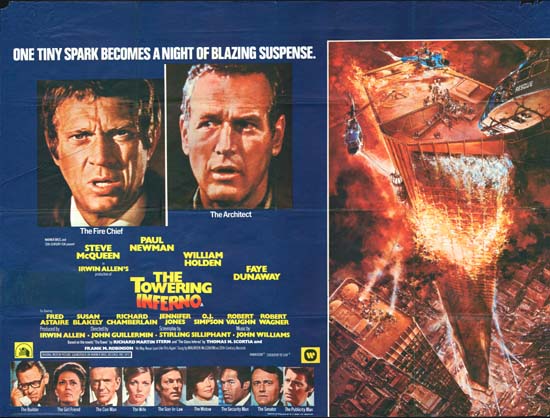
Made at the height of the disaster movie boom by the studio that created the genre’s touchstones, Jaws was inevitably cast in the mould of another tale of group jeopardy, and so the film demanded a central set piece of mass panic. Audiences had paid good money to see people perish in a capsized ocean liner (The Poseidon Adventure), burnt to a crisp in a glass skyscraper (The Towering Inferno), and crushed by falling buildings (Earthquake). There was no reason to doubt that they wouldn’t do the same to see people being devoured by a man-eating shark. But, in fact, what ultimately made Jaws such a hit was not its pretensions to big-scale action, but its more intimate interaction between the principal characters. The beating heart of the movie is the tale of three men in a boat.

Wednesday, September 24, 2014

Tourists On The Menu


The opening shot of the montage is of a ferry coming in to dock, its upper deck crowded with tourists. A triangular yellow sign, framed in the centre of the screen, offers a subliminal colour-coded warning to the holidaymakers. There is a cut to an enlarged monochrome picture of the dead shark taken for The Amity Gazette on display on the sea front. Its prominence is a clever piece of PR, no doubt intended as a public service message to give the lie to the scaremongering graffiti on the billboard from the previous scene. Tourists walk past the image and the camera pans with them from right to left, tilting up to reveal the docked ferry. On the right of the frame a stall, decked out with flags and red, white and blue bunting, is selling shark souvenirs, a confirmation that Amity is, indeed, ‘open for business’.There is a cut to a medium close shot of Brody pacing his den while on the phone. The camera follows him as he moves right to left and then latches onto Hooper - also in mid-phone conversation – as he comes into frame from the opposite side. As Brody’s voice continues on the soundtrack, there is a cut to a shot from inside the ferry as its doors open and passengers begin to disembark, their figures black silhouettes against the bright primary colours of Amity's waterfront. It’s as if we are seeing the potential victims from inside the belly of the beast, a figurative POV shot of the shark’s great maw. 


As the tourists come off the boat - some on foot, some wheeling bicycles, some in cars - there is a cut back to Brody and Hooper in the den, now joined by the chief’s wife and younger son, one helping and the other hindering their work. With the exception of the early scene when Brody types out the coroner’s report in the police station, the movie locates key moments (Brody getting the phone call about the first victim, Brody researching sharks, Hooper describing the territoriality theory over dinner, the two men recruiting shark spotters) in the home. The threat to the family unit that the domestic setting implies is finally made explicit when Michael Brody narrowly escapes becoming the shark’s sixth victim in the estuary.

The montage of tourists continues with a sequence of shots: two yellow tour buses at a busy intersection manned by a white-gloved traffic cop, an elderly couple, another cop (no doubt one of the extra summer deputies) directing traffic with blasts of a whistle, a low-angle shot of tourists milling about, a woman in a nun’s habit, a close-up of a sign that reads Sight Seeing. Tours. Bikes. Car Rentals, a shot of another ferry docking, a middle-aged black woman in a red floppy hat, more cars, and more tourists with their heads cut off by the top of the frame. All this is orchestrated to a John Williams music cue, which has a celebratory baroque tone that adds a sense of pageantry to the arrival of the off-islanders. On the soundtrack album, the cue is given the classically-sounding title of ‘Promenade’, and – in parentheses – the more playful one of ‘Tourists on the Menu.’ The assembly of shots does not, however, aim for satire: there are no signs of the chubby holidaymakers munching on hot dogs that would appear in a similar montage sequence in the movie’s sequel. Although not quite cinema verite, the scenes here are clearly candid shots of real tourists arriving on Martha’s Vineyard, and even the individuals picked out by the camera (the nun, or the lady in the red hat) look like ordinary people, not Hollywood extras. 


There is a final cut back to the Brody house, where Matt Hooper is on the phone to an operator trying to get a connection whilst Martin and Ellen are deep in conversation in the background. Outside the windows the sea dominates the view, providing a visual foreshadowing of the watery horizons seen from the cabin of the Orca. The snatches of dialogue we hear from Brody in the interpolated phone scenes serve to highlight both his desperation (‘We’ve gotta have help - anybody with a gun or a boat.’) and determination (‘Okay, now I want to know how many men you’re gonna send me.’) Hooper’s first line echoes the exasperation he felt at the mayor’s stonewalling (‘Doctor, doctor, there is no need for me to come to Brisbane when I have a Great White shark right here!’) as well as referencing the minor plot point of his upcoming research trip. He is also given a complete non-sequitor (‘Mishkin? Mishkin is the guy that feeds the white mice.’), which one can only suppose is all that remains of a longer piece of freewheeling improvisation by Dreyfuss.

The montage comes to a close with a further sequence of shots: tourists carrying beach umbrellas and picnic baskets in a stiff breeze, a bicycle rental shop with a red bicycle hung outside as a sign, the intersection with the yellow tour bus still waiting to turn the street, and a final shot of another ferry arriving from Woods Hole as the music on the soundtrack swells to a dramatic conclusion.

Saturday, August 23, 2014

May The Fourth Be With You


The extended Fourth of July sequence, which takes the film to the mid-point of its running time, begins with the first of the movie’s two montages: intercut between shots of tourists arriving on the island is a scene in which Brody and Hooper work the phones in a frantic attempt to recruit shark spotters. At least, the general interpretation of the narrative assumes that the action takes place on the holiday. If we assume that what we are seeing in the montage is tourists arriving on the morning of 4th July then the grammar of film editing implies that the frantic phone calls interspersed between these shots is happening at the same time. Logic, however, dictates that Brody and Hooper - having been given carte blanche by Larry Vaughn to protect the community (“Now, if you fellows are concerned about the beaches, you do whatever you have to to make them safe.”) - would have manned the phones as soon as they’d finished arguing with the mayor, on the 3rd. Despite the desperate nature of Brody’s phone calls, (“We’ve got to have help, anyone with a gun or a boat.”), the chief manages to marshal a tightly-knit team to patrol the beaches: uniformed men equipped with walkie-talkies and shark repellent, armed with rifles, and prepped with code protocols (“Red one! Red one! Get the people out of the water!”). And yet, instead of the meetings and briefings that such logistics would require, we get only a few snatches of telephone conversations. Antonia Quirke sees this as ‘a light parody of the putting-on-a-show, last minute panic scene’, but this may be attributing a greater meaning to the scene than was intended. Ultimately, the Brody/Hooper phone conversations are simply movie shorthand, signalling to the audience the improvisational nature of the community’s response to the shark problem.  

Saturday, July 5, 2014

Inserts


‘Even masterworks have their blemishes,’ writes Nigel Andrews in his bite-sized Bloomsbury guide to Jaws. On the back of this proposition he goes on to argue that the Fourth of July scene is a failure, criticising it for being ‘scattered tonally between satire […] and suspense’. I don’t share this view; or rather, I don’t see this tonal shift as a criticism – in fact, one of the strengths of the movie is the way it navigates so expertly between humour and horror. I do agree, however, that a masterpiece can be flawed. There is one shot in Jaws lasting only a few seconds that always makes me wince - like the Amity folk reacting to the sound of Quint’s fingernails on the blackboard. Larry Vaughn has made his final pronouncement (‘[…] tomorrow is the Fourth of July and we will be open for business.’) and is about to depart. As if to emphasise the finality of the decision, a road sign with an arrow stamped with the legend ONE WAY - hidden up to this point by the figure of Vaughn standing by his car - is revealed when the mayor climbs in behind the wheel. As Vaughn drives out of shot Brody turns and looks off-screen to the left, and then we cut to that fingernail-grating insert. Matt Hooper is seated in profile on a pale rock on the left of the frame. Behind him and to the right is a line of curious sightseers gawping at the billboard, which is out of shot. Hooper turns his head to acknowledge Brody’s gaze and seems to look directly into the camera. There’s something staged and clunky about the moment. It’s partly to do with the way Dreyfuss turns his head, a gesture that seems like a response to a director’s cue rather than a natural piece of acting, and partly due to the fact that Spielberg (or editor Fields) holds the reaction shot for a beat too long. The fact that John Williams’s neo-baroque montage music cue announces itself with this exchange of glances only exacerbates the moment of artifice.

Sunday, June 22, 2014

Signs


Larry Vaughn’s description of the graffitied billboard (‘a deliberate mutilation of a public service message’) is – on the surface – a typical example of the mayor’s propensity to speak in the jargon of the bureaucrat. It’s an idiolect that uses vocabulary for the purposes of obfuscation, turning ‘a shark attack’ into ‘a boating accident’, hiding the truth behind big words and burying meaning in serpentine sentence constructions. It comes to the fore later in the mayor’s brief interview with the TV reporter on the Fourth of July, and is also evident in that other public service message, the No Swimming sign that we see being erected on the windswept beach in the wake of the town hall meeting. With its connotations of cutting and tearing, the word ‘mutilation’ stands out, however, as a rather unfortunate choice of word, the kind of verbal misstep that politicians are wont to make. It could be read as a Freudian slip, prompted by the scene depicted on the billboard, which itself is a parody of the movie’s opening scene of cutting and tearing. It could also be read as an indication that Larry Vaughn’s carefully constructed pronouncements are beginning to crack under pressure. Indeed, in his very next sentence, he abandons any pretence of linguistic control and expresses himself in more direct and emotional language (‘I want those little paint-happy bastards caught and hung up by their Buster Browns.’) The reference to a brand of kids’ shoes suggests the mayor is assuming the vandalism is the work of children. The euphemism – which seems to have been coined here – may seem a relatively innocent expression, but it belies the fact that Larry Vaughn is advocating emasculation as a punishment for the vandals. Hooper, like Vaughn, also abandons the idiolect of his public persona during the course of the scene, and ends up treating the mayor like a child, framing his argument as a third grade show and tell (‘All this machine does is swim and eat and make little sharks …. Now, why don’t you take a long close look at this sign.’). As the two men spar with words, the sign behind them – as big as a movie screen – transmits its unreconstituted public message that Amity has a shark problem.


Saturday, June 21, 2014

Bring Me The Head Of Benjamin Gardner


Despite Quint’s assertion that a ‘fish like that’ll swallow you whole’, Ben Gardner does not completely disappear down the shark’s gullet. His head - like Chrissie’s arm, which washes up in the surf - provides graphic undigested evidence of the attack.  The remains that the shark leaves behind become food for creatures lower down the food chain: the girl’s ravaged limb is picked upon by scuttling crabs and screaming sea birds; the fisherman’s left eye is nibbled out of its socket by tiny fish, not dissimilar perhaps to the ones that flit across the screen in the opening shot. Ben Gardner’s head undergoes a ‘sea-change’ more gruesome than the one described by Ariel in his song in Shakespeare’s The Tempest. What better, then, than this grisly transformation – far more persuasive than the missing shark’s tooth - to convince the mayor to close the beaches? And yet, no mention is made of it – it is rather the fisherman’s boat that Brody proffers as Exhibit A (‘It was all chewed up. I helped tow it in. You should have seen it-’).
The reason, of course, that no mention is made of Ben Gardner’s head (which the viewer can assume has been deposited in a plastic bowl in the morgue alongside the remains of the first victim) is simply that it had not been written into the script by the time the scene on the bluff was filmed.  It played no part in the boat discovery scene as it was originally written (and partly filmed), which Carl Gottlieb makes clear on page 84 of The Jaws Log

‘We were filming a scene in which Brody and Hooper, accompanied by Meadows, are at sea in a small boat, looking for evidence of a great white shark. The script calls for them to find the wrecked hull of a local fisherman’s boat. They tie up alongside it, closer examination shows terrible damage, Hooper puts on a wet suit and dives to inspect its hull, and prises the tooth of a villainous shark out of the hull.’ 

This description is closer to the scene in Chapter Five of the novel where Brody and Hendricks pull alongside the deserted craft, and the deputy pulls a two inch ‘triangle of glistening white denticle’ out of the transom.  In the book we never learn if Ben Gardner’s body, or any part of him, is recovered, although Brody does reflect that if any remains wash ashore they will become ‘a gory nuisance’.