Monday, December 26, 2011

Hey Marty

Brody is interrupted in his shark spotting by Mrs Taft's husband. Mr Taft, a middle-aged businessman, interposes his tanned bulk between the chief and the ocean so that Brody has to look over the man's shoulder to keep his eye on the water activity. Taft's big head looms on the right of the frame and the tiny head of a girl swimmer - just a speck in the water - is in the far background on the left. The split focus gives a sense of depth and ensures that the viewer's attention, like Brody's, is held by the smaller of the two images within the frame.


The second false alarm occurs when the girl swimmer cries out as if taken by something below the surface. She rears up out of the water on the shoulders of her boyfriend, her scream more playful than fearful. Brody again raises himself out of his chair in reaction, settling back down when he realises his mistake. Taft, unaware of the threat, is more concerned with mundane matters. His little monologue of complaint about parking misdemeanours encapsulates the small town nature of Amity police work and also hints at the way those in authority are manipulated by those with influence ('You can take care of it. You've done it before.').

Taft's idiolect ('I've got some cats parking in front of the house') betrays his age as much as his greying hair, and his use of the overly-familiar form of Brody's first name may also be a hangover from the Fifties.

Saturday, December 24, 2011

Bad Hat

 
Brody is distracted by two red herrings (one visual and one aural) before the real fish strikes without warning. The first is a black shape in the water just beyond the overweight woman. There is a cut to Brody's anxious reaction as he raises himself slightly from his seated position and then a shot that reveals the suspected fin to be nothing more than the black bathing cap of another of Amity's elderly residents. Another reaction shot shows Brody looking askance with a mixture of relief and self admonition. As a participant in the action, Brody has no visual or aural clues that will help him identify the presence of the shark. For him every suspicious movement in the water could be a threat. As viewers of the action, the audience, however, has been primed by the opening scene to associate the shark with an underwater POV shot and the throbbing music of the score. Although we do not feel the same misplaced anxiety as the main character, there remains a tension throughout the scene that dervies from the fact that we know something must happen, and we too, like Brody, are on the edge of our seats.

Thursday, December 15, 2011

Wipe Out

Having established the geography of the beach with fluid tracking shots, Spielberg adopts a series of quick cuts that set up a number of bathers as potential shark food. The first  - a POV from Brody's perspective - is a medium shot of the overweight lady floating on her back. The young man with the lemon polo shirt runs across the frame from left to right, obscuring the view, and then we cut to a medium close up as he throws the stick for his dog. This, and the following shots that are all seen from varying low angles, are clearly not intended to be showing what Brody is seeing. In pursuit of the stick the dog races into the water, where a young couple is canoodling in the shallows. There is another cut to Mrs Kintner in profile as Alex runs past her with his raft, and this is followed by another low angle shot as the boy launches himself onto the ocean. With each shot the camera has become closer to the water so that as viewers we almost feel as if we are in it as well. The next shot is of the dog swimming with the stick in his mouth and being intercepted by a male bather. Then we cut back to the overweight lady, still kept afloat by her bulk and slowly turning in a clockwise direction. Another cut to Alex on his raft, propelling himself with kicks of his legs and a two-armed paddle stroke. The images are accompanied by the sound of splashing and water activity.


The next cut returns us to dry land with a medium shot looking along the beach from a reverse angle to the establishing one. A song on the radio provides ambient background music. The beach - a crescent of white sand - is almost deserted and the most conspicuous items on it are two more empty lifeguard stations. The boy and his dog are having a playful tug-of-war. There is a travelling shot of the dog prancing in surf, and then we cut to a medium shot of Brody. He has shifted his position to one side of his chair and leans his right elbow over the back of the metal frame. His hands are clasped - just as they will later be in the dinner table scene with his son - and his right leg is crossed in a manly fashion over his left. His posture suggests something between relaxation and attentiveness. It is almost as if he is literally on the edge of his seat, waiting for something to happen.

Abandoning the rapid cutting technique, Spielberg now moves from shot to shot with clever imitation wipes. A bather passes in front of the camera, briefly obscuring our view of the watchful police chief. As the bather moves out of the frame we are aware that the shot has moved in closer. Another passer-by wipes the screen and we move even closer. The combination of the 'wipe' and the cut create a single fluid image. Compare this scene to Mrs Brenner's discovery of the eyeless corpse in The Birds where Hitchcock creates a jarring effect by cutting closer on the same image. In Frenzy the same director used an imitation wipe to cheat in the creation of a long travelling shot: watch for the moment when the Covent Garden porter passes across the frame with a sack of potatoes, seamlessly joining together studio and location work. 


In the grammar of film a cut can be used within scenes or to move from scene to scene. Traditionally, a fade or dissolve is used to indicate the passing of time and as such is rarely used within a single scene (although, off the top of my head, I can think of examples in Citizen Kane and Taxi Driver). A wipe is most frequently used to indicate both a change of time and location, or - in this beach scene- as a sleight of hand, like some of the camera tricks of Georges Melies. Like the Iris-in and Iris-out of the silents, the wipe has become rare in modern cinema unless it is being used in a post-modernist ironic way, or - as in the Star Wars movies - as a kind of retro throwback.

Spielberg uses cuts when he allows us to be the observer of the action and 'wipes' when he wants us to watch it through Brody's eyes. The contrast of the staccato rhythm of the former and the perceived fluidity of the latter helps to create a kinetic tension that builds to the 'Vertigo moment' when the screen seems to expand and contract at the same time.

Thursday, December 8, 2011

It's Only An Island If You Look At It From The Water


On his way to collect his raft from the beach hut, Alex Kintner passes Ellen Brody, who is sunbathing on the beach and conversing with a dark-haired woman (Mrs Taft according to the IMDB credits, but anonymous in the movie itself). Snatches of inconsequential dialogue can be heard, but it is Ellen's question ('When do I get to become an islander?') and Mrs Taft's response ('Never! You're not born here, you're not an islander.') that register.

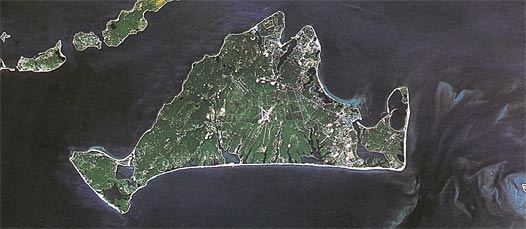
In Benchley's novel the town of Amity is located on the western end of Long Island, a twenty-minute drive from Sag Harbor. Long Island somewhat belies its geographical status by lying flush against the mainland and being connected to it by both bridges and tunnels. When you look at it from the water or even from space, its large mass of almost one and a half thousand square miles looks more like a peninsula. In the movie Amity becomes an island unto itself, more akin to Martha's Vineyard, which was where the film was shot and which looks like an island from wherever you view it. In fact, although nominally set in a recognisable east coast location, Amity is about as real as the village of Brigadoon or that other famous Scottish village from Local Hero.

In the novel Brody is a local, but finds himself increasingly isolated from his community - a story element that was emphasised by the publisher's hype (... one man against a giant killer shark and a town that won't face the truth!). In the film, Brody is an off-islander, figuratively and - at the movie's climax - literally out of his depth, but he finds unlikely companionship in his quest to kill the shark. At the very end of the movie he is reunited with Hooper and the two men share a brief moment of poignancy as they acknowledge Quint's sacrifice with a realisation that no man is an island.

Monday, December 5, 2011

Watching The Detective

 
Alex walks towards the beach huts to get his raft, stepping between reclining sunbathers. The camera moves with him and halts as the profile of Brody comes into view in the foreground, dominating the right side of the frame. The concentrated stillness of the chief's gaze sets him apart from the rest of the people of the beach, and his right hand is held to his mouth in a typical gesture of deep thought. His posture can also be read as an emblem of his complicity in the cover-up of the first attack: forbidden to speak, he is, at least, determined to be on the lookout for any further threat.

The scene is as much about Brody being watched as it is about him watching. Shots alternate between what he sees and his reactions to it in a textbook example of the Kuleshov effect. As an audience we share with him the knowledge that none of the other participants in the scene have, and so his heightened expressions of dread become ours. In a sense, we are watching our own reactions up on the screen.

Throughout much of the movie, Brody is placed in the position of observer. At key moments he directs his gaze out towards the ocean, and - particularly in the presence of Hooper - he is relegated to the role of onlooker, first as the fish expert delivers medical analysis in the morgue scene, then fillets the tiger shark in a 'half-assed autopsy', and later explores Ben Gardner's half-submerged boat.

Brody sits in his chair throughout almost the entire scene: what, after all, could be more emblematic of an observer than a seated posture? Even when there is an appearance of a threat, Brody does nothing more drastic than half-rise to a crouching position, and when his view is blocked he simply shifts his beach chair a few inches in irritation. Even at the moment of the attack, he remains rooted to the spot - it is the camera and indeed the image that react with movement.

Friday, December 2, 2011

That Little Kintner Boy


As the overweight lady walks into the sea she passes a young man in cut off jeans and a pale lemon polo shirt, who is playing with his black labrador in the surf. He throws a stick into the ocean and the dog races after it. A skinny boy in red bathing trunks (the same fire engine red as the boat of the estuary victim) emerges from the sea. The camera reverses its right-to-left movement and follows him up the beach until he plops down in front of a woman, whose face is hidden by a floppy yellow sun hat. Their brief exchange hints at the prickly relationship of a nervous child and an over-protective mother. Interestingly, the boy's name is telegraphed to the audience, just as the first victim called out her own name minutes before her death.

Given a final ten minutes on the water (and, in fact, a final few minutes of life), Alex Kintner gets up and walks further up the beach. The camera follows him, pulling back to reveal more of the background where we can see first one and then two tall lifeguard chairs, both unoccupied and facing the ocean. Painted the same white as the picket fences, they are totems of a false sense of security.


In the book, Alex is six years old, but in the movie he's ten or eleven, more or less the same age as Brody's elder son. He was played by twelve year old local Jeffrey Voorhees, who coincidentally shares the same surname as another iconic movie monster. Mrs Kintner also seems to have been aged for the movie version - at times, she looks old enough to be the young boy's grandmother. Played by another local (Lee Fierro), the actress was, in fact, forty five when she was cast in the role. Benchley never fully describes her in the book, but the illustrated Reader's Digest version of the novel portrays her as a leggy blonde with Jackie O. sunglasses and a DePalma transvestite psycho fright wig.

Wednesday, November 30, 2011

Super Size Me

The ferry scene concludes with an abrupt cut to a crowded beach. There is no establishing wide shot and it is only after the camera has panned and tracked across the entire beach that we get some sense of the geography of the scene. The first figure we see is that of an overweight woman. Dressed in a striped bathing costume, she strides purposefully into the ocean, the skin on her arms and legs puckered and wrinkled by folds of fat. This was no doubt intended to provoke an ironic smile, but the potential for developing the 'people as food' motif would have to wait until Jeannot Szwarc cut together a montage of plump holidaymakers snacking on hot dogs for his beach scene in Jaws 2.


Back in the 1970s obesity levels in the US were not as high as they are today, and - with the exception of a few well-fed selectmen and some beer-bellied fishermen - there is no much evidence of a weight problem in Amity. Indeed, if you look at the figures scrambling out of the sea during the Fourth of July panic, it's difficult to see any evidence of bad diet.