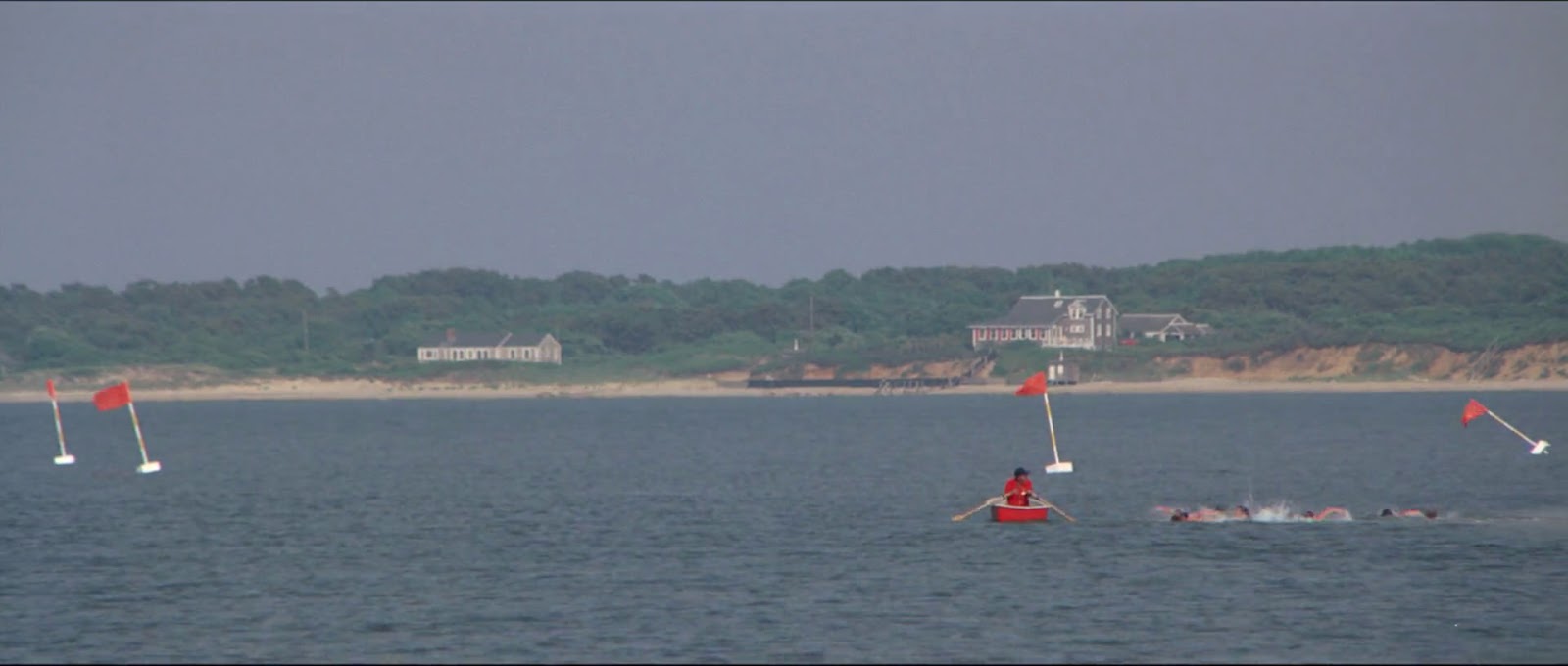
The ferry scene opens with a long shot of a stretch of water, a strip of beach in the background and beyond that green vegetation. Two marker buoys with red flags are positioned close together on the right of the screen with a third on the far left. On the right side of the frame a group of six swimmers can be seen splashing vigorously in pursuit of a man in a red tracksuit rowing a red boat. It's quite possible that this is the same red boat that will be capsized by the shark in the pond and if it is then the estuary victim was Amity's local scoutmaster.
Red has long been visual shorthand for danger. Hitchcock drenched the screen in it to convey hysteria in Marnie and even inserted a few crimson frames to the otherwise monochrome Spellbound for maximum dramatic effect. Brian de Palma's Blow Out, M.Night Shayamalan's The Sixth Sense and The Village, and Douglas Sirk's Written on the Wind are a few of the titles that immediately come to mind when thinking of the use of red as a visual signifier.
Spielberg made a decision early on in pre-production to avoid the colour as much as possible so that when the ocean turned red in the shark attack scenes the impact would be all the greater. In transferring Jaws from the page to the screen the most significant adjustment in the colour scheme was to make the Orca's barrels bright yellow - in Benchley's original novel they are red. Yellow is the preferred colour for safety and rescue equipment at sea because of its high visibility, and for the same reason is commonly used as a background to warning signs. The movie exploits this safety/threat binary through its use of the colour and conditions the viewer to respond to it with a growing feeling of unease.
Wednesday, November 2, 2011
Tuesday, November 1, 2011
Loading Zone
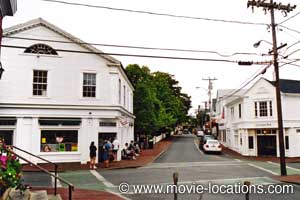
Brody comes out onto the sidewalk in front of the hardware store just as Hendricks arrives in the police jeep. As soon as the chief spots the vehicle, he makes a 'pull over' gesture with the wooden stakes he's holding under his right arm and the deputy comes to a halt by the kerb just beyond a spot that is marked LOADING ZONE in pale yellow paint. Perhaps it was the presence of such prohibitions on the streets of the movie location (the junction of Walter Street and Main Street in Edgartown) that gave Carl Gottlieb the idea of working the motif into the script.
Hendricks brings news of one of the 'water activities' Brody has asked for ('a bunch of boy scouts out in April Bay doing their mile swim for their merit badges') and the chief immediately devolves responsibility for the sign making to the deputy - with the proviso that Polly does the printing. Hendricks's sulky response ('What's the matter with my printing?') is one of several moments in the movie that identifies his character as a man-child, well-meaning but naive. Brody gets into the jeep from the passenger side and sidles over on his rear to get behind the wheel. It's an ungainly action, but it serves to save precious seconds of screen time and the need for a repositioning of the camera. Besides, if you look at movies from the Forties and Fifties, it seemed to be common enough practice. Detective Arbogast does it, for example, in Psycho when he returns to the Bates Motel even though he is exiting the vehicle.
As Brody drives away, a voice off-screen calls 'Hey, chief' and there is a cut to a dapper looking man emerging from one of the buildings across the street. Mayor Larry Vaughn is the third and final member of Amity's political triumvirate to be introduced in this fashion. Coming down the steps behind him are the medical examiner and Meadows, who is in conversation with a Teamster-looking type next to be seen at the town hall meeting. Clearly, the powers-that-be have taken no time in getting into a huddle to discuss strategy. On the porch a young woman in a green shirt and yellow slacks is wrapping patriotic bunting of red, white and blue around one of the building's columns. Vaughn calls again after the departing police vehicle and this time his tone has an edge to it. The brief expression of thwarted authority that crosses the mayor's face as one of his public servants fails to heed his call tells us everything we need to know about this scheming politician.
In a reverse shot we see Hendricks crossing the street, laden down with the sign making equipment, and the mayor joins him at the centre of the intersection just as the local marching band swings past on a practice run. The deputy has to shout over the noise in order to make himself heard. It's both an aural and visual representation of the movie's dilemma: the two men are surrounded by organised jollity and as the band plays on no one takes any heed of the potential threat.
Hendricks brings news of one of the 'water activities' Brody has asked for ('a bunch of boy scouts out in April Bay doing their mile swim for their merit badges') and the chief immediately devolves responsibility for the sign making to the deputy - with the proviso that Polly does the printing. Hendricks's sulky response ('What's the matter with my printing?') is one of several moments in the movie that identifies his character as a man-child, well-meaning but naive. Brody gets into the jeep from the passenger side and sidles over on his rear to get behind the wheel. It's an ungainly action, but it serves to save precious seconds of screen time and the need for a repositioning of the camera. Besides, if you look at movies from the Forties and Fifties, it seemed to be common enough practice. Detective Arbogast does it, for example, in Psycho when he returns to the Bates Motel even though he is exiting the vehicle.
As Brody drives away, a voice off-screen calls 'Hey, chief' and there is a cut to a dapper looking man emerging from one of the buildings across the street. Mayor Larry Vaughn is the third and final member of Amity's political triumvirate to be introduced in this fashion. Coming down the steps behind him are the medical examiner and Meadows, who is in conversation with a Teamster-looking type next to be seen at the town hall meeting. Clearly, the powers-that-be have taken no time in getting into a huddle to discuss strategy. On the porch a young woman in a green shirt and yellow slacks is wrapping patriotic bunting of red, white and blue around one of the building's columns. Vaughn calls again after the departing police vehicle and this time his tone has an edge to it. The brief expression of thwarted authority that crosses the mayor's face as one of his public servants fails to heed his call tells us everything we need to know about this scheming politician.
In a reverse shot we see Hendricks crossing the street, laden down with the sign making equipment, and the mayor joins him at the centre of the intersection just as the local marching band swings past on a practice run. The deputy has to shout over the noise in order to make himself heard. It's both an aural and visual representation of the movie's dilemma: the two men are surrounded by organised jollity and as the band plays on no one takes any heed of the potential threat.
Monday, October 31, 2011
Summer Ginks
Brody enters the hardware store to find yet another disgruntled Amity resident in conversation with the storekeeper. The customer's complaint plays over the scene as Brody walks between the shelves of gardening implements and household tools in search of paints and brushes. On the surface it seems like just some background noise, but in fact it dovetails neatly with two of the movie's intertwining themes: the economic imperative and the basic impulse to survive.
The dissatisfied customer is clearly one of the many islanders who depends on the summer tourists for his livelihood, and, like many such people, he refers to his clients in mildly derogatory terms ('the summer ginks'). His supply chain has been disrupted ('You haven't got one thing on here I ordered. Not a beach umbrella, not a sun lounger, no beach balls.') and the prospect of a financially successful season is under threat ('This stuff ain't going to help me in August.'). The litany of beach accessories - completely innocent in itself - acts as a kind of grim counterpoint given the knowledge that both Brody and the audience possess in much the same way that a neighbour's innocent repetition of the word knife plays on the murderess's guilt in Hitchcock's Blackmail (1929).
The customer's last but incomplete line ('If I can't get service from you, I'll go and get service from -') is later echoed in Larry Vaughn's observation of economic competition ('If the people can't swim here, they'll be glad to swim at the beaches of Cape Cod, the Hamptons, Long Island.'). The movie's pop critique of capitalism appealed to Fidel Castro, who praised the film for its Marxist sympathies in conversation with Francis Ford Coppola.
The brief scene in the hardware store ends with another instance of Brody's clumsiness, cutting to the next scene as a jar of paint brushes crashes onto the shelf.
The dissatisfied customer is clearly one of the many islanders who depends on the summer tourists for his livelihood, and, like many such people, he refers to his clients in mildly derogatory terms ('the summer ginks'). His supply chain has been disrupted ('You haven't got one thing on here I ordered. Not a beach umbrella, not a sun lounger, no beach balls.') and the prospect of a financially successful season is under threat ('This stuff ain't going to help me in August.'). The litany of beach accessories - completely innocent in itself - acts as a kind of grim counterpoint given the knowledge that both Brody and the audience possess in much the same way that a neighbour's innocent repetition of the word knife plays on the murderess's guilt in Hitchcock's Blackmail (1929).
The customer's last but incomplete line ('If I can't get service from you, I'll go and get service from -') is later echoed in Larry Vaughn's observation of economic competition ('If the people can't swim here, they'll be glad to swim at the beaches of Cape Cod, the Hamptons, Long Island.'). The movie's pop critique of capitalism appealed to Fidel Castro, who praised the film for its Marxist sympathies in conversation with Francis Ford Coppola.
The brief scene in the hardware store ends with another instance of Brody's clumsiness, cutting to the next scene as a jar of paint brushes crashes onto the shelf.
Main Street
The next scene begins with an exterior shot of an empty street. White picket fencing marks the boundaries of properties on both sides of the road, and the houses that can be seen behind leafy trees are of white clapboard. A branch of pink blossom hangs over the upper left portion of the frame. Brody emerges from a building on the far side of the street, delivering a line of continuity dialogue as he opens the gate. As he begins to march purposefully down the street a cyclist in a blue shirt passes him in the opposite direction. The long shadow he casts in front of him is a reminder that it's still early morning. The camera executes a reverse track to the corner of the street and swivels to follow Brody as he passes a green fire hydrant. Just before the cut to a different angle, Brody breaks his stride with a little skip. As he walks, a sequence of sound effects (a dog barking, birds singing, and the distant sound of a high school band) help to suggest the idyllic nature of the community. The geometric precision of the white fencing and the gleaming white facades are in stark contrast to the twisted broken fencing on the beach. Here at least there is an appearance of harmony and orderliness - even the fire hydrant has been painted in the same colours as the shutters of the houses that line the street.
As Brody passes one of these houses a man in a charcoal suit emerges. Although we do not yet know that this is the medical examiner with whom Brody has just spoken, his sombre clothing - more in keeping with an undertaker than anything - sets him apart from the bright summer imagery that infuses the scene. In contrast, the next character to step out onto the street in Brody's wake is Harry Meadows, the editor of Amity's local newspaper. His powder blue linen suit is at least more in keeping with the season. Intent on his purpose, Brody notices neither of the two men, but their convenient appearance just as he walks by suggests the way in which the Amity grapevine works. As he marches down the slope towards the town's main intersection, Brody is accosted by another elderly resident, one of several seemingly interchangeable old codgers who harry the chief at different moments in the film. On this occasion the complaint is about the karate school kids, but Brody deflects it once again.
In contrast to the almost deserted streets through which Brody has just walked, the town centre is bustling with activity. Cyclists and pedestrians (including a woman in a yellow trouser suit) mill about under a large banner proclaiming the forthcoming Fourth of July celebrations. The sound of a whistle accompanies Brody as he crosses the street, like an echo of the one that summoned him to the grisly discovery on the beach.
As Brody passes one of these houses a man in a charcoal suit emerges. Although we do not yet know that this is the medical examiner with whom Brody has just spoken, his sombre clothing - more in keeping with an undertaker than anything - sets him apart from the bright summer imagery that infuses the scene. In contrast, the next character to step out onto the street in Brody's wake is Harry Meadows, the editor of Amity's local newspaper. His powder blue linen suit is at least more in keeping with the season. Intent on his purpose, Brody notices neither of the two men, but their convenient appearance just as he walks by suggests the way in which the Amity grapevine works. As he marches down the slope towards the town's main intersection, Brody is accosted by another elderly resident, one of several seemingly interchangeable old codgers who harry the chief at different moments in the film. On this occasion the complaint is about the karate school kids, but Brody deflects it once again.
In contrast to the almost deserted streets through which Brody has just walked, the town centre is bustling with activity. Cyclists and pedestrians (including a woman in a yellow trouser suit) mill about under a large banner proclaiming the forthcoming Fourth of July celebrations. The sound of a whistle accompanies Brody as he crosses the street, like an echo of the one that summoned him to the grisly discovery on the beach.
Sunday, October 30, 2011
Coroner's Report
Polly's account of the karate school kids is interrupted by the telephone. She picks up on the first ring and barely gives the medical examiner time to speak before she passes the call to Brody, who, cradling the receiver on his shoulder, acknowledges it with a terse interrogative 'yeah'. He then aligns the report in the typewriter and types the words SHARK ATTACK as the Probable Cause of Death. The scene is lifted directly from the novel, but dispenses with a conversation between the coroner and the police chief that implies a cordial relationship between the two men. In the film the medical examiner is virtually silent - speaking only when directed by the Mayor and voicing opinions that have been foisted on him. Behind his thick-framed Henry Kissinger glasses, the expression on his face shifts as easily as his conscience.
The brief close up of the report in the typewriter tells us that the victim of the attack was a student and that the time of death was estimated at 11.50 p.m. The date is given as 7-1-74, which will prove to be a continuity error in the movie's time line when the second shark victim is attacked on the twenty ninth of June. More immediately noticeable, however, is a spelling mistake: the word coroner has been typed out twice as corner. Unlike the typos in Jack Torrance's manuscript, this is unlikely to be a subtle indication of character, but simply poor spelling from the movie's props department. The report is in any case destined to be thrown away - or amended, as the medical examiner puts it - and the document Hooper consults in the mortuary scene gives 'probable boating accident' as the cause of death.
Polly tries to reassert her position by setting the morning's agenda, but Brody, rising from his desk, interrupts her with a request for 'a list of all the water activities that the city fathers are planning today.' The reference suggests a government of benign patronage and benevolent wisdom and, when the authorities gather to announce the temporary beach closure, it's no surprise that they are made up exclusively of men. In Jaws women are relegated to supporting roles - the caring mother in Ellen Brody, or the grieving one in Mrs Kintner.
As Brody leaves his office, the camera tracks back and then pans with him as he heads for the exit, executing a reverse of the shot that opened the scene. With the exception of the cutaway to show the police report, the whole scene has in fact been filmed in a single take. Brody asks Hendricks about the beach closed signs. The deputy's bewildered response ('We never had any.') prefigures Meadows's comment ('We never had that kind of trouble in these waters.') on the ferry.
Brody pulls on his windcheater and, dodging an elderly resident who has come to complain about illegal parking, makes for the exit. There is a curious detail of wardrobe that is never explained: over his right shoulder Brody is wearing what looks like an orange towel, just as he had in the earlier scenes at home. He pulls his jacket on over it, but this time there is no wife to pull it teasingly from him. It has, at any rate, disappeared by the time he emerges onto the street in the next scene. If there is any reason for this piece of wardrobe, it is never given, and one can only speculate that his character is such a bundle of neuroses that he requires the comfort of a security blanket.
Saturday, October 29, 2011
Wax On Wax Off
Not yet having been brought up to speed on the shark attack, Polly's main concern is the nine year old kids who have been karateing the picket fences. She recounts Amity's latest crime wave in a folksy idiom ('...we got a bunch of calls...') and a comically bewildered tone that is accompanied by an equally comic mime of a karate chop. In contrast to the Amity of Peter Benchley's novel (which is riddled with real violence and corruption), the community in the movie is a cosy place where crime is limited to quirky high jinks of karate vandals or the low level misdemeanors of tourists parking in red zones.
By the mid Seventies the craze for martial arts - kick-started by the twin successes of Enter the Dragon (1973) on the big screen and the David Carradine show Kung Fu (1972 - 1975) on the small - was in full swing. James Bond had already jumped on the bandwagon with an Eastern-themed adventure in The Man with the Golden Gun (1974), as had the dying Hammer horror studio in the same year with The Legend of the Seven Golden Vampires. Sam Peckinpah would demonstrate the balletic quality of hand to hand combat in The Killer Elite (1975). The song Kung Fu Fighting by Carl Douglas was a disco hit the year Jaws was being filmed. The popularity of chop-socky cinema at the time helps to put Amity's nine year old vandals in some kind of cultural context, but the association of karate and fences wouldn't be made explicit in American cinema again until the middle of the next decade.
Sunday, October 23, 2011
Let Polly Do The Printing
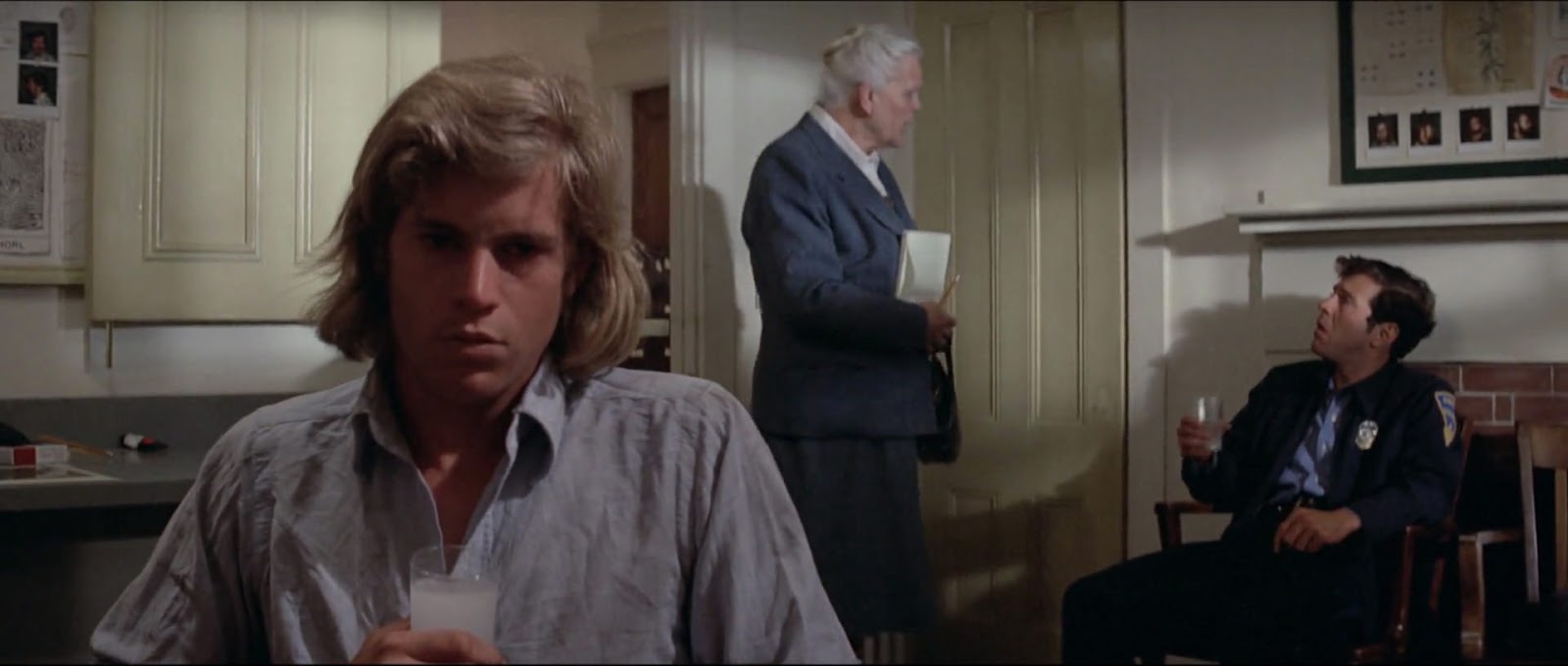
The next scene - the only one to take place in the Amity police station - opens with a shot of a traumatised Cassidy sitting in the foreground on the left of the frame with Patrolman Hendricks in the background on the right. Each man has a glass of a pale milky liquid in his hand, a mixture no doubt concocted to settle their queasy stomachs. While Cassidy seems unaware of the glass in his hand, Hendricks sips at his like a boy who has been given a soda as a treat. There is the sound of a door opening and closing and Polly - a plump white-haired woman in grey tweed - steps into the room. She addresses Hendricks in a surprised tone, and her greeting ('Well, you're up awful early.') hints at Amity's low crime rate as well as the somewhat folksy nature of its police force. This latter point is reinforced by the woman's character itself, which is quickly established as that of a slightly scatty matriarch. Hendricks motions her towards the sound of typing that is coming from off-screen and Polly marches past a bulletin board on which is pinned an image of the stars and stripes and the legend This Is Our Flag Be Proud Of It.
\
The camera pans with her and tracks behind her as she enters the chief's office. Brody is at his desk, typing. He ignores his secretary's question ('What have you got on today?') and gives her a gentle reminder about the new filing system, suggesting the minor power struggle that exists between them. The camera comes to a momentary halt as Brody and Polly have their initial exchange, and a third of the screen on the left is obscured by the wall and door jamb. As Polly comes around the desk, the camera moves over the threshold to reveal a composition of vertical, horizontal and diagonal lines provided by shadows on the wall, the fixtures and furniture of the interior and the partial view of a pitched roof outside the window. Like the earlier images of the skewed vertical slats of the broken fencing along the beach, the geometry of the frame provides the viewer with a subliminal visual message. The message itself is a contradiction, one that suggests a sense of dislocated order, and it is a concept that will inform both the community's initial attempts to keep the monster at bay and the final improvised strategies employed by the three men who are chosen to hunt it down.
The brief but memorable role of Polly was given to a non-professional actress called Peggy Scott. Like the other locals cast in the movie, she was chosen because she looked and sounded the part. Her delivery gives the dialogue an almost improvisational feel, whilst both the pitch of her voice and her general demeanor look forward to the diminutive ghostbuster played by Zelda Rubinstein in Poltergeist.
Subscribe to:
Posts (Atom)