Ellen gets home from her tryst at 4.30. Those watching the clock know that she arrived at Banners restaurant at 12.30 and had to wait fifteen minutes before Hooper arrived. By the time they were ready to order it must have been close to one. The restaurant was practically empty and so their food came quickly. At a conservative estimate they had probably paid the bill and left by 1.30. How long would it take them to find a suitable motel where the walls weren't made of "Kleenex and spit"? Let's be generous and say thirty minutes. Then maybe another twenty minutes to register as husband and wife, and a few more minutes to "scout around". So by the time they're alone, it would be two thirty in the afternoon. Given that Ellen needs a minimum of twenty minutes to drive home, that gives the lovers about ninety minutes.
Ellen and Hooper's "coupling" is seen through Ellen's eyes, as a memory after the fact, and it's presented as a violent, atavistic act - described in the text as "an assault". Ellen falls asleep with images of Hooper's climax playing on a loop in her head, and is woken by her husband. Their conversation continues as Brody goes into the bathroom to relieve himself, and Ellen contemplates the capacity of the male bladder. And so the chapter ends with her husband holding his flaccid penis in his hand whilst Ellen's mind brims with images of another man's erection.
Tuesday, May 3, 2011
Leatherette
If the most memorable moment from Jaws the movie is that of the shark's head rearing up out of a fresh chum slick, one of the novel's unforgettable images appears on page 150 as Ellen Brody - seated opposite Matt Hooper in a dark restaurant - begins to get hot and bothered:
"She felt hot, flushed, and sensed that her mind was floating somewhere apart from her body. She was a third person listening to the conversation. She had to fight to keep from shifting on the Leatherette bench. She wanted to squirm back and forth, to move her thighs up and down. But she was afraid of leaving a stain on the seat."
Once inside your head, this kind of detail is difficult to dislodge, and it gets caught up with all the other threads of trivia that are snagged in the memory. Years ago I read an article in The New Yorker - ironically, I forget by whom - lamenting the fact that Shakespeare, Tolstoy and Emily Dickinson get tangled up with advertising jingles, catchphrases and movie dialogue. She (and I seem to remember the author was female) quoted the very passage above, despairing that it lived in her memory alongside an image of sunlight glinting on a jar of honey from a picnic in Anna Karenina.
It's not difficult to sympathise with her. My own head is full of useless trivia that takes precedent over useful information. I can't tell you what the speed of light is, but I do know that the Millennium Falcon made the Kessel Run in less than twelve parsecs. I can't speak German or Spanish, but I can recognise Klingon, Romulan and Na'vi. I can't perform CPR, but I would be willing to administer an adrenalin shot to the heart if I had a Magic Marker pen.
I also know a thing or two about Leatherette. A form of artificial leather, it is made by covering a natural or synthetic fabric base with polyvinyl chloride (PVC). It can be used as a book binding, as upholstery inside a BMW, as a finish on an SLR camera, as clothing (both conventional and kinky), and, of course, as seat covers.
Unlike real leather, Leatherette is not naturally porous and does not allow air to pass through it, which is why a car seat can often feel hot and sticky on a summer's day. Hence Ellen's fear that the natural process of female sexual arousal might stain the seat.

"She felt hot, flushed, and sensed that her mind was floating somewhere apart from her body. She was a third person listening to the conversation. She had to fight to keep from shifting on the Leatherette bench. She wanted to squirm back and forth, to move her thighs up and down. But she was afraid of leaving a stain on the seat."
Once inside your head, this kind of detail is difficult to dislodge, and it gets caught up with all the other threads of trivia that are snagged in the memory. Years ago I read an article in The New Yorker - ironically, I forget by whom - lamenting the fact that Shakespeare, Tolstoy and Emily Dickinson get tangled up with advertising jingles, catchphrases and movie dialogue. She (and I seem to remember the author was female) quoted the very passage above, despairing that it lived in her memory alongside an image of sunlight glinting on a jar of honey from a picnic in Anna Karenina.
It's not difficult to sympathise with her. My own head is full of useless trivia that takes precedent over useful information. I can't tell you what the speed of light is, but I do know that the Millennium Falcon made the Kessel Run in less than twelve parsecs. I can't speak German or Spanish, but I can recognise Klingon, Romulan and Na'vi. I can't perform CPR, but I would be willing to administer an adrenalin shot to the heart if I had a Magic Marker pen.


I also know a thing or two about Leatherette. A form of artificial leather, it is made by covering a natural or synthetic fabric base with polyvinyl chloride (PVC). It can be used as a book binding, as upholstery inside a BMW, as a finish on an SLR camera, as clothing (both conventional and kinky), and, of course, as seat covers.


Unlike real leather, Leatherette is not naturally porous and does not allow air to pass through it, which is why a car seat can often feel hot and sticky on a summer's day. Hence Ellen's fear that the natural process of female sexual arousal might stain the seat.

Wanna Get Drunk and Fool Around?
Sliding into one of the restaurant's corner booths, Ellen orders a gin and tonic and downs half of it as soon as the waitress brings it to her table. She has another with Hooper when he arrives and contrives to drink a third by deliberately delaying her choice of meal. In a Molly Bloom-like internal soliloquy, she wonders whether the booze will affect either her judgement or her tongue, and then - echoing the porter in Macbeth - worries "about alcohol increasing the desire but taking away the performance." The one thing she doesn't seem concerned about is whether the alcohol level in her blood is likely to impair her driving ability. As she shares a bottle of wine with Hooper, their conversation becomes increasingly explicit, and so too do Ellen's thoughts as she imagines them both as Ballardian victims of a road accident, caused not by DUI but by a fantasy of mutual masturbation.
In 1938 Professor Rolla N Harger invented the breathalyser and his home state of Indiana became the first to establish a blood alcohol concentration (BAC) of 0.15% as a means of defining impairment - a figure that remained the legal limit until the early Seventies when it was reduced to 0.10%. Officers believing a driver to be intoxicated could use a Field Sobriety Test (FST) to confirm their suspicions. In the 1950s when Roger Thornhill was charged with drunk driving in Hitchcock's North by Northwest, FSTs were far from sophisticated and the test was not always consistently applied. The Grand Rapids Study of 1964 demonstrated that a BAC as low as 0.4% was enough to increase a diver's likelihood of being involved in an accident, and it was this study that led to the eventual tightening of the law in the Seventies.
Peter Benchley - like many of his contemporaries and like the characters of his book- would have thought nothing of getting behind the wheel of a car after a few drinks.


In 1938 Professor Rolla N Harger invented the breathalyser and his home state of Indiana became the first to establish a blood alcohol concentration (BAC) of 0.15% as a means of defining impairment - a figure that remained the legal limit until the early Seventies when it was reduced to 0.10%. Officers believing a driver to be intoxicated could use a Field Sobriety Test (FST) to confirm their suspicions. In the 1950s when Roger Thornhill was charged with drunk driving in Hitchcock's North by Northwest, FSTs were far from sophisticated and the test was not always consistently applied. The Grand Rapids Study of 1964 demonstrated that a BAC as low as 0.4% was enough to increase a diver's likelihood of being involved in an accident, and it was this study that led to the eventual tightening of the law in the Seventies.


Peter Benchley - like many of his contemporaries and like the characters of his book- would have thought nothing of getting behind the wheel of a car after a few drinks.

Monday, May 2, 2011
Sexed Up
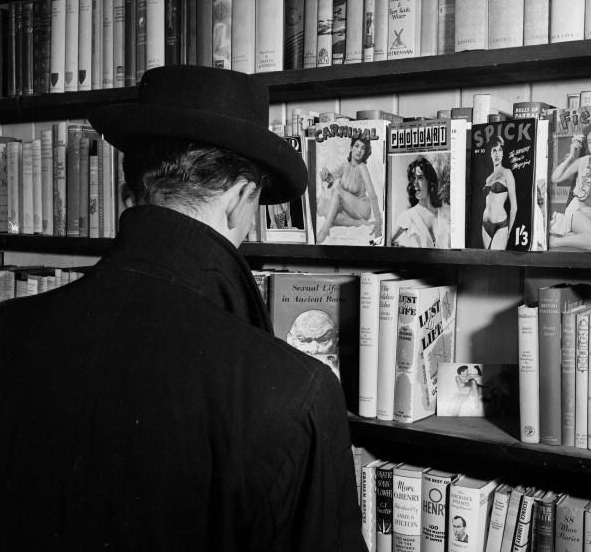
From Samuel Richardson's Clarissa to any number of current chick-lit titles, sex has always been an essential ingredient for a successful bestseller. Poet Philip Larkin famously wrote: 'Sexual intercourse began / In nineteen sixty-three / (Which was rather late for me) / Between the end of the Chatterley ban / And the Beatles' first LP.' Larkin himself dabbled in mild erotica as an author and in hardcore porn as a reader. There has always been pornography for those who want to find it - either under the counter or on the top shelf - but it wasn't really until the Sixties that sex began to establish itself in mainstream popular culture. Ian Fleming's Bond novels - which had a first publication run from 1953 to 1966 - marked a transition phase. The books were known for their sex, snobbery and sadism: there were plenty of opportunities for Bond to engage in foreplay and indulge in a post-coital cigarette of Balkan and Turkish tobacco, but the sexual intercourse itself always took place between the chapters. Fleming's descriptions are never more than titillating, and there's even an element of the bodice-ripper in his style. Bond gets aroused but the reader is never asked to picture his erection.
By 1973 all false modesty had been discarded. That year saw the publication of Jacqueline Susan's Once Is Not Enough, a trashy potboiler that included the mass rape of a convent of nuns by Nazi soldiers and climaxed with heroine January Wayne participating in an explicitly described orgy. I found a paperback copy of the novel by my parents' bedside and read parts of it - the parts that Mary Whitehouse would have called 'mucky.' It was always easy to find these bits in any book that circulated around school: you could either let the book fall open at the page where the spine was most cracked or identify the sections from the darker edge of the well-thumbed pages. Strangely though, the one abiding image I retain from the book is of a Coca Cola bottle that the young January takes from the refridgerator in the kitchen of her uncle's Rome apartment. To be able to take a bottle of pop from the fridge without having to ask seemed to me to be the height of decadence.




By 1973 all false modesty had been discarded. That year saw the publication of Jacqueline Susan's Once Is Not Enough, a trashy potboiler that included the mass rape of a convent of nuns by Nazi soldiers and climaxed with heroine January Wayne participating in an explicitly described orgy. I found a paperback copy of the novel by my parents' bedside and read parts of it - the parts that Mary Whitehouse would have called 'mucky.' It was always easy to find these bits in any book that circulated around school: you could either let the book fall open at the page where the spine was most cracked or identify the sections from the darker edge of the well-thumbed pages. Strangely though, the one abiding image I retain from the book is of a Coca Cola bottle that the young January takes from the refridgerator in the kitchen of her uncle's Rome apartment. To be able to take a bottle of pop from the fridge without having to ask seemed to me to be the height of decadence.

Sunday, May 1, 2011
Guilt Trip
Brody wakes the morning after the dinner party to find the bed beside him empty. Ellen - already decided on her course of action - sits by the window, her mood reflected by the weather. Even the "[rain]drops sliding down the glass" seem to have a lachrymal quality about them. Although her husband is aware of her "subdued sad" mood, he does not suspect the cause of it, and their brief exchange threatens to start another fight between them.
As soon as she is alone in the house, Ellen begins to make her elaborate preparations. In these there are interesting parallels with the details of Marion Crane's flight from Phoenix in Psycho. Both women are exposed to the observer (i.e. reader/viewer): Ellen showers and then stands naked before the mirror to assess her looks; Marion - no doubt fresh too from a shower that we can see in the background - has changed into black bra and panties. Once dressed, she too contemplates herself in the mirror in an attempt to stare down her own conscience. For both women there is a moment of doubt before the final decision. We get inside Ellen's head as she asks herself: "Were the goods good? Would the offer be accepted?". Marion says nothing, but Hitchcock's camera work and Bernard Herrmann's nagging score tell us all we need to know. On Marion's bed - beside the envelope of stolen money - is an open suitcase full of clothes. Ellen packs a plastic shopping bag with the items she will need to carry out her deception.
Marion has already got off early from work by pleading a migraine. Ellen tells her supervisor that "her thyroid was acting up again ... and she was getting her period." She sneaks out of the hospital and drives to a gas station in Sag Harbor, where she asks to use the ladies' room. Here she guiltily changes from her work clothes into a lavender summer dress, "looking at her reflection in the mirror above the sink." In a similar scene in Psycho Marion Crane counts out the money to buy a used car in a futile attempt to allay the suspicions of a highway patrolman.
Both women eventually arrive at cheap roadside motels although the respective fates they meet after having a meal are, of course, quite different. There is, nevertheless, something violent about the way Hooper climaxes. There's even a sentence that seems to echo the iconic music that underscores Marion Crane's death: "From his voice there came a gurgling whine, whose tone rose higher and higher with each frenzied thrust."
The key difference between these two parallel journeys is that Ellen Brody goes through with her 'crime' whereas Marion Crane resolves to pull herself out of the private trap she has created. Her conscience, however, comes too late to save her. Despite a brief "twinge of shame" that strikes Ellen on page 154, she remains unrepentant.
It's extremely unlikely that Peter Benchley actually modelled his chapter on the early structure of Hitchcock's film, but the duplication of imagery - like guilty reflections in a mirror - is intriguing.
Guess Who's Coming To Dinner
The dinner party scene of Chapter Seven gives an indication of what Jaws might have been like written as mild satire, as Benchley had originally intended. It's not laugh-out-loud funny, but it does have elements of a comedy of manners. Ellen's desperate attempts to impress her guests - the silverware, the tulip wine glasses, the fancy menu and French wine - are undermined by her husband's boorish behaviour. Brody is more comfortable with a blue collar supper of a bologna and cheese sandwich and a beer than gazpacho soup and butterfly lamb. He serves his wife's drink with his thumb in the glass, mispronounces the wine as he serves it (Mount Ratchet) and is genuinely bemused when Ellen (mis)uses the French word for corkscrew.
Brody feels threatened by the presence of Hooper in his house and from the start of the evening is a begrudging host. He is further enraged by Daisy Wicker's hippy philosophy and her pot and grass stories - as a late-blooming flower child, Daisy is appropriately named. His anger builds to an almost psychopathic fury. "That Wicker bitch was right about one thing, Brody thought as he slashed the meat: I sure as shit feel alienated right now." He takes refuge in the bottle and, using the alcoholic's tactic of taking two drinks for every one he serves his guests, gets drunk.
Some of these elements did find their way into the movie - Brody's lack of knowledge about wine ("You might want to let that breathe") and his slightly slurred speech - but they are played for laughs. In the film Brody gets endearingly tipsy, but in the book he is an ugly drunk, teetering on the edge of violence.
Funny How?
According to Peter Benchley's editor Tom Congdon, the first draft of Jaws started out on "the wrong track" by aiming for a comic tone. Perhaps Benchley felt an obligation to carry on the family tradition. His grandfather Robert Benchley made a successful career out of a dry metropolitan sense of humour without even seeming to try very hard. He was part of the Algonquin Round Table, whose members included Dorothy Parker, George S Kaufman, and Harold Ross. Ross was the famed editor of The New Yorker - required reading for sophisticated city dwellers - and Benchley's pieces in that magazine made his name. He dabbled in a film career, appearing in among other things Hitchcock's Foreign Correspondent, and produced a series of spoof How To ... shorts, one of which (How To Sleep) won an Academy Award. His humour was self-deprecating, rather gentle and eminently quotable:


'Drawing on my fine command of the English language, I said nothing.'
'There are two kinds of people in the world, those who believe there are two kinds of people in the world and those who don't.'
'I do most of my work sitting down; that's where I shine.'
'I have tried to know absolutely nothing about a great many things, and I have succeeded fairly well.'
He liked to present himself as being slightly befuddled by the sophisticated circles in which he moved. On visiting Venice for the first time, he sent a telegram to Harold Ross that read: 'Streets full of water. Please advise.'
His son Nathaniel followed in his footsteps and became a professional author. He wrote books for children, a biography of his father, and a number of novels - the most famous of which is the gentle Cold War satire The Off-Islanders. He served in the U.S Navy during the Second World War and, had the USS Indianapolis not "delivered the bomb" and helped end the conflict, he would most likely have seen action in the Pacific. He survived the war and lived to see his son Peter's success with Jaws, even suggesting a title - Who's That Noshin' On My Laig? -when the book was in manuscript form.

With such a pedigree, it's not surprising that the third writer in the family should try his hand at comedy. The instincts of his editor -'humour isn't the proper vehicle for a great thriller' - were probably right, but it seems that by steering Benchley away from the comic, Congdon succeeded in draining any residual humour from the book. In contrast, the movie makes its audience laugh and scream. As Pauline Kael - film critic of The New Yorker - rightly observed in her review, it is 'one of the most cheerfully perverse scare movies ever made.'
Subscribe to:
Posts (Atom)