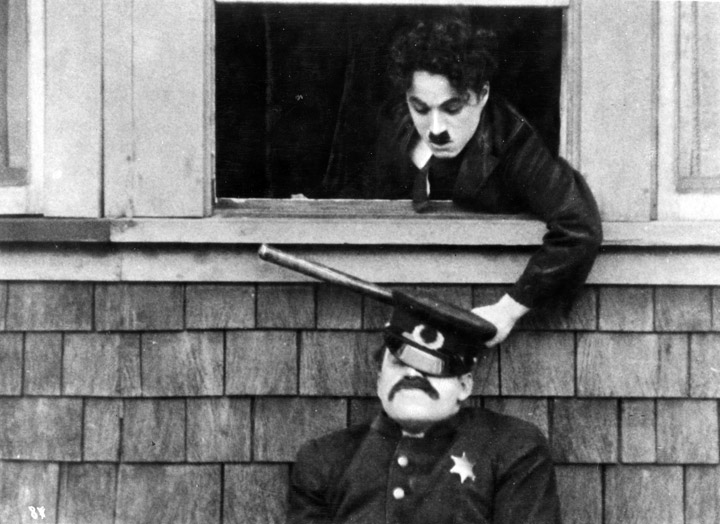
In American cinema the role of the uniformed police officer has varied across time, genre and setting. In the silent movies he - and, up until the Nineties, it invariably was a man - was an authoritarian figure to be mocked and ridiculed. With the arrival of talking pictures he became an established bit part player, always on hand to keep back the crowd or lead the villain down to the cells. No Hollywood version of small town America would be complete without its friendly cop on the beat. An avuncular friend, he was more ready to hand out homespun advice than speeding tickets - just as in the big cities of Hollywood musicals the police officer was there to offer nothing more than a mild rebuke. Film noir, of course, offered up a more ambivalent picture of those who took the pledge to protect and serve. The year 1960 provided a new perspective and, as that decade of anti-authoritarianism progressed, cinema goers became used to seeing the police painted in increasingly darker shades of blue.
1973 - the year Peter Benchley delivered his manuscript - saw the release of three films that neatly encapsulated the perceptions of the American police force in the popular imagination. In Serpico Al Pacino ratted out his corrupt colleagues in the NYPD. The John Milius-scripted Magnum Force had Clint Eastwood taking on a gang of cloned motorcyle cops acting as vigilantes. The Seven-Ups cast Roy Scheider as an undercover cop willing to bend and even break the law in order to secure a collar.
That same year saw the start of the hit CBS show Kojak. Like Starsky and Hutch and later Cagney and Lacey that were to follow it, Kojak avoided the moral ambiguities of law enforcement that were being played out on the big screen. With advertisers to please and the need to wrap up a story within an hour, Seventies cop shows painted police work with broad strokes in bright primary colours.
Closer to reality was the depiction of the profession in popular fiction. Detective fiction in the US had produced a good number of private eyes - from Philip Marlowe and Sam Spade to Ellery Queen and Lew Archer - but it was writers like Ed McBain and Joseph Wambaugh who popularised the police procedural novel.
There's not much evidence in the text of Jaws to suggest that Peter Benchley devoted a great deal of research into small town law enforcement. He gives us forensic-level detail of Ellen Brody's preparations to commit adultery - "From the back of her closet she took a plastic shopping bag into which she put a pair of bikini underpants, a bra, a neatly folded lavender dress, a pair of low-heeled pumps, a can of spray deodorant, a plastic bottle of bath powder, a toothbrush and a tube of toothpaste." - but tells us next to nothing about her husband's working practices. Indeed, we read more of Brody at home than of him in the local precinct. When he interacts with members of the public, he is quick to become antagonistic, and his handling of basic procedures - such as informing loved ones of a person's death - would have brought him up before the police commission.
Saturday, April 23, 2011



Friday, April 22, 2011
Bad Twin
Jaws the movie and Jaws the novel have always had a rather uneasy relationship. Although Spielberg was full of praise for the book's potential as a cinematic experience, he was equally vocal about its shortcomings - specifically Benchley's inability to create likeable characters. When offering Richard Dreyfuss the part of Hooper, Spielberg urged the actor not to look at the source material. It was a wise piece of direction. Had Dreyfuss read the character as written, even he might have doubted his ability to pull it off.
Physically, Hooper on the page is quite different from the Hooper on screen. When he steps forward on the dock to shake hands with Brody, he is described as being "mid-twenties ... and handsome: tanned, hair bleached by the sun ... an inch over six feet ..." Dreyfuss was twenty seven when he signed on for the movie, a year younger than his director. According to his IMBD page, Dreyfuss is five foot five.
In the novel the shark expert is every inch the priveleged WASP, a Yale graduate with the standard preppy wardrobe of Lacoste shirts and Weejun loafers. From the description on the page, an unimaginative casting director would have been more likely to call Richard Chamberlain, whose Roger Simmons in The Towering Inferno is the perfect blueprint for Benchley's Hooper.
Brody takes an instant disliking to Hooper and, like some kind of primate, immediately sizes him up as a potential threat. Within pages of meeting, the two men are locking horns. By Part Three they are at one another's throats. It is difficult too for the reader to sympathise with Hooper. Although he is referenced at several points early in the text, he does not make an appearance until page seventy six. By then our loyalties - such as they are - lie with Brody and so, inevitably, we see Hooper through his eyes.
In the movie the character dynamic experiences a seismic shift. When Brody and Hooper shake hands in the harbormaster's hut, they seem to hit it off immediately, and within minutes of screen time they are on first name terms. Scheider's Brody is not in the least threatened by Dreyfuss's Hooper, even when the newcomer trespasses on his home territory. Indeed, the banter and interplay between the police chief, his wife and the expert from the oceanographic institute has a Hawkesian innocence about it.
The one element of Hooper's character that does make it to the screen is his enthusiasm for his subject. In the book he's given several paragraph-long monologues that might have been cut-and-pasted from National Geographic. In the movie, when Hooper first sees the shark, his first instinct it to take pictures of it, coaxing it with his lens like a top fashion photographer ("Come on, darling! Come here, darling! Beautiful!").
Like it or not, the movie Hooper could not exist without the book's. We may enjoy the effervescence of Dreyfuss's performance, but we have to remember that - like the portrait of Dorian Grey - there is a darker, more complex character hidden up in the attic.
Physically, Hooper on the page is quite different from the Hooper on screen. When he steps forward on the dock to shake hands with Brody, he is described as being "mid-twenties ... and handsome: tanned, hair bleached by the sun ... an inch over six feet ..." Dreyfuss was twenty seven when he signed on for the movie, a year younger than his director. According to his IMBD page, Dreyfuss is five foot five.
In the novel the shark expert is every inch the priveleged WASP, a Yale graduate with the standard preppy wardrobe of Lacoste shirts and Weejun loafers. From the description on the page, an unimaginative casting director would have been more likely to call Richard Chamberlain, whose Roger Simmons in The Towering Inferno is the perfect blueprint for Benchley's Hooper.

Brody takes an instant disliking to Hooper and, like some kind of primate, immediately sizes him up as a potential threat. Within pages of meeting, the two men are locking horns. By Part Three they are at one another's throats. It is difficult too for the reader to sympathise with Hooper. Although he is referenced at several points early in the text, he does not make an appearance until page seventy six. By then our loyalties - such as they are - lie with Brody and so, inevitably, we see Hooper through his eyes.
In the movie the character dynamic experiences a seismic shift. When Brody and Hooper shake hands in the harbormaster's hut, they seem to hit it off immediately, and within minutes of screen time they are on first name terms. Scheider's Brody is not in the least threatened by Dreyfuss's Hooper, even when the newcomer trespasses on his home territory. Indeed, the banter and interplay between the police chief, his wife and the expert from the oceanographic institute has a Hawkesian innocence about it.


The one element of Hooper's character that does make it to the screen is his enthusiasm for his subject. In the book he's given several paragraph-long monologues that might have been cut-and-pasted from National Geographic. In the movie, when Hooper first sees the shark, his first instinct it to take pictures of it, coaxing it with his lens like a top fashion photographer ("Come on, darling! Come here, darling! Beautiful!").

Like it or not, the movie Hooper could not exist without the book's. We may enjoy the effervescence of Dreyfuss's performance, but we have to remember that - like the portrait of Dorian Grey - there is a darker, more complex character hidden up in the attic.


Monday, April 18, 2011
That's Not Writing, That's Typing
Like Jack Torrance in the Overlook Hotel, Peter Benchley would have hammered out his manuscript on a manual typewriter. Each blank sheet of paper would have to be inserted into the platen and properly aligned, and at the end of every line the carriage would have to be returned manually. As the pages built up in a neat stack on his desk, the ink on the page would gradually fade until the ribbon would have to be changed. Typing was a physical and sometimes dirty chore. Mark Twain was one of the first authors to submit a typed manuscript to his publisher, although his claim that Tom Sawyer was the first novel to be written on a typewriter is generally disputed. Even if it's not true, it seems right. There is something particularly American about the typewriter and the detritus that surrounds it.
Of his writing habits, Benchley said, 'I sat in the back room of the Pennington Furnace Supply Co. in Pennington, New Jersey, in the winters, and in a small, old turkey coop in Stonington, Connecticut, in the summers, and wrote what turned out to be Jaws.' Benchley was not driven by a strong creative impulse to tell a story. It took him seven years to get the initial idea down on paper and then it took the encouragement of his editor Tom Congdon and a thousand dollar advance to flesh the story out to one hundred pages. From 1971 to 1973 (winters in the back room, summers in the turkey coop) Benchley wrote and rewrote the still untitled manuscript. It's unlikely, however, that much of that time was devoted to honing the language of the book.
'It is easy', says Nigel Andrews in his pocket movie guide on Jaws, 'to pick out bad passages.' He quotes a line from Chapter Five to illustrate his point: "Brody felt a shimmy of fear skitter up his back." Can a shimmy actually skitter? Isn't that rather like a jump leaping, or a hop skipping?
A few pages on Brody breaks the bad news to Ben Gardner's wife, a scene which Benchley records in a sentence that becomes as snarled as one of Quint's keg lines:
"She seemed calmer, but Brody was sure that the calm was a lull before the burst of grief that would come when she realized that the fears which she had lived with every day for the sixteen years she and Ben had been fishing professionally - closet fears shoved into mental recesses and never uttered because they would seem ridiculous - had come true."
It would be easy enough to trawl through the entire novel, netting an entire catch of cliches, purple prose and clunky phrasing, but - to mix a metaphor - that would be a bit like shooting fish in a barrel.


Of his writing habits, Benchley said, 'I sat in the back room of the Pennington Furnace Supply Co. in Pennington, New Jersey, in the winters, and in a small, old turkey coop in Stonington, Connecticut, in the summers, and wrote what turned out to be Jaws.' Benchley was not driven by a strong creative impulse to tell a story. It took him seven years to get the initial idea down on paper and then it took the encouragement of his editor Tom Congdon and a thousand dollar advance to flesh the story out to one hundred pages. From 1971 to 1973 (winters in the back room, summers in the turkey coop) Benchley wrote and rewrote the still untitled manuscript. It's unlikely, however, that much of that time was devoted to honing the language of the book.

'It is easy', says Nigel Andrews in his pocket movie guide on Jaws, 'to pick out bad passages.' He quotes a line from Chapter Five to illustrate his point: "Brody felt a shimmy of fear skitter up his back." Can a shimmy actually skitter? Isn't that rather like a jump leaping, or a hop skipping?
A few pages on Brody breaks the bad news to Ben Gardner's wife, a scene which Benchley records in a sentence that becomes as snarled as one of Quint's keg lines:
"She seemed calmer, but Brody was sure that the calm was a lull before the burst of grief that would come when she realized that the fears which she had lived with every day for the sixteen years she and Ben had been fishing professionally - closet fears shoved into mental recesses and never uttered because they would seem ridiculous - had come true."
It would be easy enough to trawl through the entire novel, netting an entire catch of cliches, purple prose and clunky phrasing, but - to mix a metaphor - that would be a bit like shooting fish in a barrel.
There's A Clinical Name For It, Isn't There?
Aquaphobia is a fear of water, or more specifically a fear of being immersed in water. The symptoms include dizziness, nausea, trembling, sweating and an increased heart rate - what Brody remembers his mother calling "the wimwams." The reference to a childhood memory is a relevant one. Anyone who has learnt to swim as a child can relate to the fear of being in an element which has the ability to swallow and suffocate them. Those who carry a fear of water into their adult life most likely do so as the result of a childhood incident. Extreme aquaphobes may be freaked out by a bathtub or even a glass pitcher. Of the many recorded phobias, a fear of drowning is one that most of us can relate to - certainly more so than a random selection of other fears such as caligynephobia, ereuthrophobia or omphalophobia.
In Jaws it is not simply the water itself, but the creatures which inhabit it that we fear. In describing Brody's own fear of the water, Peter Benchley seems to morph into Stephen King: "In Brody's dreams, deep water was populated by slimy, savage things that rose from below and shredded his flesh, by demons that cackled and moaned." The shark is demonised by Quint, who hurls religious insults at it more frequently than he hurls harpoons("God damn your fucking soul! .... Come up, you devil! .... Come out, you godforsaken sonofabitch! ..... God damn your black soul!").
One of the book's minor characters, Minnie Eldridge, possibly Amity's oldest living resident, invokes the Book of Job and is of the opinion that the shark is on some kind of perverse mission from God. Her firebrand warning seems to echo that of Elijah, whom Ishmael and Queequeg meet when they join the crew of the Pequod. Like shark victim Morris Cater, Minnie does not make it to the movie, but she does get to witness a suitably fiery death in the sequel.
In Jaws it is not simply the water itself, but the creatures which inhabit it that we fear. In describing Brody's own fear of the water, Peter Benchley seems to morph into Stephen King: "In Brody's dreams, deep water was populated by slimy, savage things that rose from below and shredded his flesh, by demons that cackled and moaned." The shark is demonised by Quint, who hurls religious insults at it more frequently than he hurls harpoons("God damn your fucking soul! .... Come up, you devil! .... Come out, you godforsaken sonofabitch! ..... God damn your black soul!").

One of the book's minor characters, Minnie Eldridge, possibly Amity's oldest living resident, invokes the Book of Job and is of the opinion that the shark is on some kind of perverse mission from God. Her firebrand warning seems to echo that of Elijah, whom Ishmael and Queequeg meet when they join the crew of the Pequod. Like shark victim Morris Cater, Minnie does not make it to the movie, but she does get to witness a suitably fiery death in the sequel.


Ghost Ship
In Chapter Five Benchley employs a narrative trope common to horror and mystery genres: the discovery and search of an abandoned area. Ben Gardner has been hired to catch the shark and has gone out on his own. When Brody spies the fisherman's boat through binoculars with no apparent sign of activity on board, he and his deputy go out to investigate. Their exploration of the abandoned craft draws on the ghost ship tradition, in which the discovery of certain signs (a cleat torn from the gunwale, scarred woodwork, bloodstains on the transom, and - the big reveal - a tooth embedded in the hull) point to one inevitable conclusion. As written, the scene has a certain cinematic quality to it. Benchley even inserts a classic Jump Scare when the radio crackles into life and startles Brody, and you can almost hear the ominous music that by rights should underscore the moment when Hendricks leans over the side to retrieve the tooth.
The pages are liberally sprinkled with maritime vocabulary (gunwale, prow, transom, stern, bow, cleat, cockpit, port and starboard), but Brody himself seems all at sea when it comes to boats - even his question to his deputy ("Do you know how to drive this thing?") betrays his ignorance. The filmmakers took this to its logical conclusion by making the character a New York City cop transplanted to an island community, but in the book Brody is a local, though clearly not one with seawater running through his veins.
By the time it reached the movie, the scene too had changed significantly: from day to night, from on board to underwater, from Hendricks to Hooper. The jump scare is turned up all the way to eleven, with a suddenly squawking radio being replaced by a one-eyed severed head. And yet Benchley's original scene was, at least in part, filmed. When British TV reporter Iain Johnstone visited the Martha's Vineyard set in 1974 he witnessed the filming of one boat drawing up alongside another, a scene that was cut short (and probably inevitably scuppered) by one of the actors falling into the water. Johnstone's report, which can be seen as a DVD extra, also eavesdrops on Spielberg and screenwriter Gottlieb riffing on the elements of the ghost ship trope. By setting the discovery of Ben Gardner's boat at night Spielberg was able to kill two birds with one stone: he increased the spooky atmosphere by adding fog and shadow, and also gave himself more control in being able to hide his studio tank work under cover of darkness.
The pages are liberally sprinkled with maritime vocabulary (gunwale, prow, transom, stern, bow, cleat, cockpit, port and starboard), but Brody himself seems all at sea when it comes to boats - even his question to his deputy ("Do you know how to drive this thing?") betrays his ignorance. The filmmakers took this to its logical conclusion by making the character a New York City cop transplanted to an island community, but in the book Brody is a local, though clearly not one with seawater running through his veins.
By the time it reached the movie, the scene too had changed significantly: from day to night, from on board to underwater, from Hendricks to Hooper. The jump scare is turned up all the way to eleven, with a suddenly squawking radio being replaced by a one-eyed severed head. And yet Benchley's original scene was, at least in part, filmed. When British TV reporter Iain Johnstone visited the Martha's Vineyard set in 1974 he witnessed the filming of one boat drawing up alongside another, a scene that was cut short (and probably inevitably scuppered) by one of the actors falling into the water. Johnstone's report, which can be seen as a DVD extra, also eavesdrops on Spielberg and screenwriter Gottlieb riffing on the elements of the ghost ship trope. By setting the discovery of Ben Gardner's boat at night Spielberg was able to kill two birds with one stone: he increased the spooky atmosphere by adding fog and shadow, and also gave himself more control in being able to hide his studio tank work under cover of darkness.
Thursday, April 7, 2011
The Night Was Humid
Chapter Five is one of five chapters in Jaws that opens with a description of the weather. The Jaws film shoot was notoriously plagued by changeable weather, which played havoc with the continuity. If like me you are a paid up member of the Cloud Appreciation Society, you can have a lot of fun spotting the way the clouds behind the Orca change from cirrus to cumulus and back to cirrus again within a single scene. But you don't have to be a cloud geek to admire the shot of Quint silhouetted against a buttermilk sky of altocumulus.
Whilst it can only infuriate a filmmaker on location, weather is there for an author to command. It has provided literature with some memorable opening sentences from the sublime to the ridiculous but it can be difficult to write about without descending into a meteorological tangle.
Benchley's occasional weather reports are accurate enough and he knows his clouds (" ...puffy cumulus clouds meandered across the sky beneath a high blanket of cirrus") but, like many an author, he takes descriptions of nature as a cue to wax poetical: "..the cloud cover had begun to disintegrate, like pieces fallen from a jigsaw puzzle. Sunlight streaked though the gaps, stabbing shining patches of blue onto the gray-green surface of the sea."
In the novel there are occasional grey skies, and scattered showers, and fog. Bad weather gives Hooper an excuse to have lunch with Ellen Brody, who on the day of her infidelity sits like a modern day Jane Eyre looking out of a rain splashed window.
In the film the sun always shines, as unreal as the cartoon image beaming down on the girl in the bikini in Amity's public service message. The town won't make summer dollars unless it has summer weather.

Whilst it can only infuriate a filmmaker on location, weather is there for an author to command. It has provided literature with some memorable opening sentences from the sublime to the ridiculous but it can be difficult to write about without descending into a meteorological tangle.
Benchley's occasional weather reports are accurate enough and he knows his clouds (" ...puffy cumulus clouds meandered across the sky beneath a high blanket of cirrus") but, like many an author, he takes descriptions of nature as a cue to wax poetical: "..the cloud cover had begun to disintegrate, like pieces fallen from a jigsaw puzzle. Sunlight streaked though the gaps, stabbing shining patches of blue onto the gray-green surface of the sea."
In the novel there are occasional grey skies, and scattered showers, and fog. Bad weather gives Hooper an excuse to have lunch with Ellen Brody, who on the day of her infidelity sits like a modern day Jane Eyre looking out of a rain splashed window.
In the film the sun always shines, as unreal as the cartoon image beaming down on the girl in the bikini in Amity's public service message. The town won't make summer dollars unless it has summer weather.

Wednesday, April 6, 2011
All The News That's Fit to Print
In both book and movie it's the media that finally blow the lid off Amity's cover up, just as Bob Woodward and Carl Bernstein revealed Nixon to be a political shark. In the movie Peter Benchley himself cameos as a TV reporter - momentarily breaking the fourth wall by addressing the camera - and delivers his lines with just the right amount of earnestness.
With his own newspaper background it's not surprising that Benchley should populate his story with newsmen: apart from local newspaper editor Harry Meadows, there is Bill Whitman, a reporter for The New York Times, and Bob Middleton "from Channel Four News".
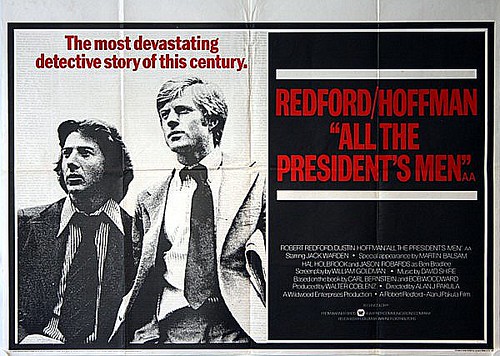
The newspaperman and - less commonly - woman has long been a convenient stock movie character for digging up dirt. From the shadowy figure of Thompson in Citizen Kane to the milk-drinking Joe Frady of The Parallax View, the hard-boiled, fast-talking reporter has doggedly followed leads through the noir landscape of American film. In the year Jaws was published the crusading reporter was given hagiographic tribute in All the President's Men.
In the novel the Times reporter, who happens to be on the beach when Alex Kintner is attacked, introduces himself as Bill Whitman, but, with a nice hint of self-importance, signs his by-line William F. Whitman. Although he reappears briefly in the final chapter, he remains a thin secondary character who doesn't make it to the final film. He simply files his copy and then fades into the background. His reporting skills are competent and he serves up the facts with journalistic precision ("At least fifteen persons witnessed the attack on Morris Cater, 65, which took place at approximately 2 P.M. a quarter of a mile down the beach from where young Kintner was attacked."). The boy's death is described in a much less lurid manner than Benchley's although there is a hint of violence in the description of the "traces of blood found on shreds of [the] rubber [raft] .." - an image that is preserved in the film. True to the motto emblazoned on its masthead, the Times bowdlerises Hendricks's description of the shark, which is now "as large as a station wagon."
The second article from The Amity Leader is couched in slightly more sensational prose and Meadows is not afraid to reach for the cliche jar: the victims were "brutally slain .... as they frolicked in the chill waters..."; Hendricks's failed rescue of Morris Cater is described as "a valiant attempt".
Although Benchley makes an effort to distinguish the two different styles of the newspapers, there is no separate font to distinguish the text of the articles from the text of the novel. We read them with Brody, interrupted by his reactions and Meadows's exegesis on the Machiavellian workings of the newspaper trade.
Meadows and Brody are themselves interrupted by Mrs Kintner - making an earlier vengeful appearance than she does in the film - and, in a telling detail, she slaps Brody across the face not with the palm of her hand but with a rolled-up newspaper.


With his own newspaper background it's not surprising that Benchley should populate his story with newsmen: apart from local newspaper editor Harry Meadows, there is Bill Whitman, a reporter for The New York Times, and Bob Middleton "from Channel Four News".
The newspaperman and - less commonly - woman has long been a convenient stock movie character for digging up dirt. From the shadowy figure of Thompson in Citizen Kane to the milk-drinking Joe Frady of The Parallax View, the hard-boiled, fast-talking reporter has doggedly followed leads through the noir landscape of American film. In the year Jaws was published the crusading reporter was given hagiographic tribute in All the President's Men.


In the novel the Times reporter, who happens to be on the beach when Alex Kintner is attacked, introduces himself as Bill Whitman, but, with a nice hint of self-importance, signs his by-line William F. Whitman. Although he reappears briefly in the final chapter, he remains a thin secondary character who doesn't make it to the final film. He simply files his copy and then fades into the background. His reporting skills are competent and he serves up the facts with journalistic precision ("At least fifteen persons witnessed the attack on Morris Cater, 65, which took place at approximately 2 P.M. a quarter of a mile down the beach from where young Kintner was attacked."). The boy's death is described in a much less lurid manner than Benchley's although there is a hint of violence in the description of the "traces of blood found on shreds of [the] rubber [raft] .." - an image that is preserved in the film. True to the motto emblazoned on its masthead, the Times bowdlerises Hendricks's description of the shark, which is now "as large as a station wagon."

The second article from The Amity Leader is couched in slightly more sensational prose and Meadows is not afraid to reach for the cliche jar: the victims were "brutally slain .... as they frolicked in the chill waters..."; Hendricks's failed rescue of Morris Cater is described as "a valiant attempt".
Although Benchley makes an effort to distinguish the two different styles of the newspapers, there is no separate font to distinguish the text of the articles from the text of the novel. We read them with Brody, interrupted by his reactions and Meadows's exegesis on the Machiavellian workings of the newspaper trade.
Meadows and Brody are themselves interrupted by Mrs Kintner - making an earlier vengeful appearance than she does in the film - and, in a telling detail, she slaps Brody across the face not with the palm of her hand but with a rolled-up newspaper.

Subscribe to:
Posts (Atom)