The next scene opens with a shot of the ocean at night, its surface wreathed in shifting banks of milky fog. A sleek white cruiser glides into the frame from the right, its motor chugging. The expensive-looking craft is a much bigger boat than the one
Hooper arrived at Amity dock in. That more modest craft is seen clearly only in the deleted scene of his approach, a shot which was abandoned when Dreyfuss failed to master the
basic seamanship required to guide it into the harbour.
An overhead shot of the rear deck shows Brody wearing an orange life jacket and clutching Hooper's second bottle of wine, pacing nervously as he gives a slightly slurred explanation of why he moved to Amity. His description of New York ('Violence, rip-off, muggings. Kids can't leave the house - you've got to walk them to school') would be familiar to the movie's contemporary audience from pictures like Klute, The French Connection and The Seven-Ups, all three of which featured performances from Scheider.
Brody's tipsy declaration that 'in Amity one man can make a difference' is undercut as a declaration of heroic principles by Hooper's response ('No kidding. Do you want a pretzel?'). Like the later example of Hooper crushing a Styrofoam cup in a mock display of machismo, it's an example of what Pauline Kael saw as Spielberg's ability to 'set up bare-chested heroism as a joke and score off it all through the movie.' By the end of the picture, when the sheriff is the last man standing (or leaning), the ironic jabs at heroism have been jettisoned in favour of a classic one-on-one showdown.
Friday, September 28, 2012
Monday, August 27, 2012
Half-Assed Autopsy On A Fish
The scene on the dock where Hooper cuts open the belly of the tiger shark is established with two quick shots: the beam of a torch and the reflection it casts on the blade of a long knife. The technique of visual shorthand is the same as the one used in an earlier dock scene where the two fishermen prepare their bait of holiday roast. The camera pulls back from the glittering blade to show Hooper's gloved hands inserting the knife into the corpse of the fish whilst Brody crouches on his haunches in the background, one hand held protectively to his face. In fact, Spielberg's original intention was to lead up to the scene with the two men approaching the dock from underneath whilst Hooper regaled the chief with a story of college telephone sex. Its exclusion from the final cut (it can be seen as a DVD extra) may have been due to running time constraints, but it was more likely the result of a decision to emasculate the character of Hooper and cast him in the role of the eager boy scout. Another element cut from the scene was the music. John Williams wrote a moody cue (in much the same vein as the music that accompanies Quint's Indianapolis speech) to underscore the action, but it was dropped by the director and only resurfaced when Joel McNeely recorded the full score with the Royal Scottish National Orchestra twenty five years later.
As Hooper saws into the shark's belly, he provides a commentary on his actions ('We start in the alimentary canal and open the digestive tract.'), which is free from the 'upper musculature' forensic gobbledygook he spouted in the Amity morgue. A milky liquid spills out onto the dock and as he reaches in to pull out the remains of undigested food he gasps for air. He tosses one whole and one half of a bonito onto the deck and they slither to a stop at Brody's feet. There is a cut to a low angled reverse shot as he throws a tin can onto the deck, and this reverts to the original master shot as he pulls out a Louisiana licence plate, which confirms his suspicions that the fish came up 'from southern waters'. Brody probably doesn't intend his question ('He didn't eat a car did he?') to be taken literally, although by the time the sequel came around the shark was taking on other modes of transportation.
Semioticians will no doubt be able to explain the significance in the number plate (007 0 981), and some might see the first three digits as a coded message for Spielberg's desire to direct a James Bond movie (a desire that prompted George Lucas to offer him Raiders of the Lost Ark), or the legend 'Sportman's Paradise' as an ironic commentary of the shark hunt. The audience is given time to register these details as Scheider picks up the number plate, twists it upright with an awkward arm movement and plays the beam of his torch over it.
Brody's need for confirmation that they have caught the wrong shark lacks any logic (Why not just present the results of their half-assed autopsy to the mayor in the morning?) as does Hooper's decision to go looking for the great white in the stretch where he has been feeding (What does he intend to do? Take a photo of it?). These blips on the story's radar, however, will be nothing compared to the gaping hole in the narrative that is soon to be revealed by the discovery of Ben Gardner's boat, and, indeed, it is this discovery that is dictating the characters' actions. The movie has been on land for long enough and it's time to go out on the water. Incidentally, another thing that doesn't quite make sense at the end of this scene is the architecture surrounding the two men. As they stride towards the boats they move through a half-complete barn-like structure that resembles nothing that we saw in the earlier daylight harbour scenes.
As Hooper saws into the shark's belly, he provides a commentary on his actions ('We start in the alimentary canal and open the digestive tract.'), which is free from the 'upper musculature' forensic gobbledygook he spouted in the Amity morgue. A milky liquid spills out onto the dock and as he reaches in to pull out the remains of undigested food he gasps for air. He tosses one whole and one half of a bonito onto the deck and they slither to a stop at Brody's feet. There is a cut to a low angled reverse shot as he throws a tin can onto the deck, and this reverts to the original master shot as he pulls out a Louisiana licence plate, which confirms his suspicions that the fish came up 'from southern waters'. Brody probably doesn't intend his question ('He didn't eat a car did he?') to be taken literally, although by the time the sequel came around the shark was taking on other modes of transportation.
Semioticians will no doubt be able to explain the significance in the number plate (007 0 981), and some might see the first three digits as a coded message for Spielberg's desire to direct a James Bond movie (a desire that prompted George Lucas to offer him Raiders of the Lost Ark), or the legend 'Sportman's Paradise' as an ironic commentary of the shark hunt. The audience is given time to register these details as Scheider picks up the number plate, twists it upright with an awkward arm movement and plays the beam of his torch over it.
Brody's need for confirmation that they have caught the wrong shark lacks any logic (Why not just present the results of their half-assed autopsy to the mayor in the morning?) as does Hooper's decision to go looking for the great white in the stretch where he has been feeding (What does he intend to do? Take a photo of it?). These blips on the story's radar, however, will be nothing compared to the gaping hole in the narrative that is soon to be revealed by the discovery of Ben Gardner's boat, and, indeed, it is this discovery that is dictating the characters' actions. The movie has been on land for long enough and it's time to go out on the water. Incidentally, another thing that doesn't quite make sense at the end of this scene is the architecture surrounding the two men. As they stride towards the boats they move through a half-complete barn-like structure that resembles nothing that we saw in the earlier daylight harbour scenes.
Monday, July 30, 2012
You May Want To Let That Breathe
Having appropriated a cliched husband/wife exchange ('How was your day?' 'Swell.') as an ironic greeting, Hooper claims Brody's uneaten meal and then nearly chokes on a forkful of food at Ellen's awkward attempt to start a conversation ('My husband tells me you're in sharks.') The light comedic tone of the scene is further established by Hooper's unlikely tale of how he first became interested in marine life. In describing his encounter with 'a four and a half foot baby thresher shark', he delivers an Indianapolis-lite monologue, deliberately playing it for laughs ('He turned an inboard into an outboard.'), which Ellen supplies as a dutiful hostess. Even when he segues into a more serious discussion of Amity's 'shark problem', the playful tone is preserved by the business of Brody pouring the wine - half a pint into his still-unfinished tumbler of scotch and then a splash for his wife and guest - and ignoring Hooper's sommelier advice.
Just as the early scene on the ferry anticipates the later confrontation between Hooper, Brody and Vaughn in front of the defaced billboard, so this dinner table scene acts as a companion piece to the moment on board the Orca when Hooper and Quint compare scars. Both scenes involve an uneaten meal, a trio of characters, one of whom is sidelined (at the dinner table, Ellen; on board the Orca, Brody), a story of an encounter with sharks (one comic, one tragic), and a shift from light-hearted banter to a darker tone. Even the way both scenes are shot (with the compositions framing two of the characters together whilst isolating the third) seem to echo each other.
Unlike the wine, the dinner table scene is allowed to breathe, with Spielberg letting the actors play out little pieces of business that lend it a sense of verisimilitude. Whilst Dreyfuss has the more showy role with his wisecracks and smirks and Lorraine Gary takes up the sentimental slack (a speech she makes about baby seals was excised from the final cut, but is available as a deleted scene), it is Scheider who once again owns the screen, peeling away at the wine bottle's cap and ever so slightly slurring his carefully considered words. The interplay between himself and Dreyfuss has a fresh improvisational feel to it, and the latter's reading of the line 'It's just a theory that I happen to agree with' is beautifully modulated.
The scene ends with Brody reasserting his authority ('I can do anything. I'm the chief of police'.) as he sinks the remainder of his wine. Is it too much to see in this act an echo of the famous moment in Rio Bravo when Dean Martin pours the whisky back into the bottle as a sign that he is taking up his responsibilities again? Certainly, the entire scene owes something to the group bonding scenes of so many Howard Hawkes movies, with its overlapping dialogue, ironic needling and bravado humour.
Just as the early scene on the ferry anticipates the later confrontation between Hooper, Brody and Vaughn in front of the defaced billboard, so this dinner table scene acts as a companion piece to the moment on board the Orca when Hooper and Quint compare scars. Both scenes involve an uneaten meal, a trio of characters, one of whom is sidelined (at the dinner table, Ellen; on board the Orca, Brody), a story of an encounter with sharks (one comic, one tragic), and a shift from light-hearted banter to a darker tone. Even the way both scenes are shot (with the compositions framing two of the characters together whilst isolating the third) seem to echo each other.
Unlike the wine, the dinner table scene is allowed to breathe, with Spielberg letting the actors play out little pieces of business that lend it a sense of verisimilitude. Whilst Dreyfuss has the more showy role with his wisecracks and smirks and Lorraine Gary takes up the sentimental slack (a speech she makes about baby seals was excised from the final cut, but is available as a deleted scene), it is Scheider who once again owns the screen, peeling away at the wine bottle's cap and ever so slightly slurring his carefully considered words. The interplay between himself and Dreyfuss has a fresh improvisational feel to it, and the latter's reading of the line 'It's just a theory that I happen to agree with' is beautifully modulated.
The scene ends with Brody reasserting his authority ('I can do anything. I'm the chief of police'.) as he sinks the remainder of his wine. Is it too much to see in this act an echo of the famous moment in Rio Bravo when Dean Martin pours the whisky back into the bottle as a sign that he is taking up his responsibilities again? Certainly, the entire scene owes something to the group bonding scenes of so many Howard Hawkes movies, with its overlapping dialogue, ironic needling and bravado humour.
Monday, June 18, 2012
I Didn't Know What You'd Be Serving
In Peter Benchley's novel an awkward dinner party provides the narrative with a set piece of mildly satirical social commentary. It's likely that this chapter was similar to the author's first draft of the manuscript, which - hard to believe in retrospect - was primarily comedic in tone. In the book Hooper is one of several invited guests and it is his openly flirtatious manner contrasted with her husband's boorish behaviour that ultimately pushes Ellen Brody into infidelity.
In the movie Hooper gate-crashes the family's evening meal, but does so with such charming social elan that he immediately wins over the chief's wife ('Wine. How nice!'). His entrance takes place in the background and out of focus as the camera remains on a brooding Brody, and recalls an earlier scene in the same kitchen when the action was split between two planes of vision. Hooper's first comment ('The door was open. Mind if I come in?') serves to illustrate the trusting nature of Amity society as well as obliquely referencing the door motif that runs throughout the movie. His brief exchange with Ellen ('Your husband's home?' 'Yes, he is.' 'I'd really like to talk to him.' 'Yes, so would I.') wittily establishes a sub-text tension between the wife and the ichthyographer that will fuel the homo-erotic imagination of future fan fiction writers.
Like any good guest - whether invited or not - Hooper has brought wine to the table, and his explanation of presenting two bottles rather than one ('I got red and white. I didn't know what you'd be serving') tees up a number of satirical visual or scripted references to dinner party etiquette.
In the movie Hooper gate-crashes the family's evening meal, but does so with such charming social elan that he immediately wins over the chief's wife ('Wine. How nice!'). His entrance takes place in the background and out of focus as the camera remains on a brooding Brody, and recalls an earlier scene in the same kitchen when the action was split between two planes of vision. Hooper's first comment ('The door was open. Mind if I come in?') serves to illustrate the trusting nature of Amity society as well as obliquely referencing the door motif that runs throughout the movie. His brief exchange with Ellen ('Your husband's home?' 'Yes, he is.' 'I'd really like to talk to him.' 'Yes, so would I.') wittily establishes a sub-text tension between the wife and the ichthyographer that will fuel the homo-erotic imagination of future fan fiction writers.
Like any good guest - whether invited or not - Hooper has brought wine to the table, and his explanation of presenting two bottles rather than one ('I got red and white. I didn't know what you'd be serving') tees up a number of satirical visual or scripted references to dinner party etiquette.
Saturday, June 9, 2012
A Boy's Life
The dock scene ends with a shot of Hooper looking on with an expression of concern as a humiliated Brody walks away from the dock. This cuts to the next scene, which takes place in the Brody's dining room. The right of the frame is dominated by an old-fashioned walnut sideboard with a set of azure napkins folded on one of its shelves, and on the left is the open doorway to the kitchen with its pale mustard fixtures. These two colours - yellow and blue - will provide the visual palette for the movie's final act at sea.
Ellen Brody, dressed in a kind of half-mourning of a black polo neck sweater and white bell-bottoms, comes through the doorway. As she walks to the table her gaze is directed off camera to the left and just before she bends down to clear away some plates she purses her lips into something that is not quite a smile - an expression that acknowledges the fact that her husband has left his meal uneaten. She gives one more meaningful look off screen and as she returns to the kitchen the camera pulls back to show Brody in profile, his bowed head resting on his supporting fist. Also in the expanded frame on the right is young Sean Brody, who has adopted the same pose as his dad. As Brody reaches out for a tall glass of what looks like scotch on the rocks, Sean takes a drink of his milk. When the father folds his hands together, the son does the same. In the background, slightly out of focus, Ellen returns with a cup of tea and leans against the door frame.
Brody covers his face with his hands in a gesture of shame and as he pulls his palms downwards, the camera cuts to a low angled shot to give us a view of his face as seen from behind the little boy's head. Out of the corner of his eye, the father notices his son's shadow play and playfully moves the fingers of his clasped hands, and then makes a face by baring his teeth - like a shark about to attack. Sean, who has lost his front milk teeth, responds with a gummy smile and makes his hands into claws. Brody leans foward and asks his son for a kiss, which he receives on his right cheek as a counter balance to the slap Mrs Kintner delivered to his left.
The sequence is underscored with a delicate nursery-rhyme-like melody played on harp, piano and vibraphone, and in the manner in which it brings a lump to the throat the scene can be rightly called Spielbergian. The use of shared body language to establish connections between characters is something that the director will return to in later films (Short Round and Indiana Jones in Indiana Jones and the Temple of Doom, or Elliott and E.T in, er, E.T), and the use of carefully choreographed business within a single shot is one of his signature techniques. Scenes around the family dinner table will also recur in later Spielberg movies, although they are more often than not moments of discord rather than harmony.
Ellen Brody, dressed in a kind of half-mourning of a black polo neck sweater and white bell-bottoms, comes through the doorway. As she walks to the table her gaze is directed off camera to the left and just before she bends down to clear away some plates she purses her lips into something that is not quite a smile - an expression that acknowledges the fact that her husband has left his meal uneaten. She gives one more meaningful look off screen and as she returns to the kitchen the camera pulls back to show Brody in profile, his bowed head resting on his supporting fist. Also in the expanded frame on the right is young Sean Brody, who has adopted the same pose as his dad. As Brody reaches out for a tall glass of what looks like scotch on the rocks, Sean takes a drink of his milk. When the father folds his hands together, the son does the same. In the background, slightly out of focus, Ellen returns with a cup of tea and leans against the door frame.
Brody covers his face with his hands in a gesture of shame and as he pulls his palms downwards, the camera cuts to a low angled shot to give us a view of his face as seen from behind the little boy's head. Out of the corner of his eye, the father notices his son's shadow play and playfully moves the fingers of his clasped hands, and then makes a face by baring his teeth - like a shark about to attack. Sean, who has lost his front milk teeth, responds with a gummy smile and makes his hands into claws. Brody leans foward and asks his son for a kiss, which he receives on his right cheek as a counter balance to the slap Mrs Kintner delivered to his left.
The sequence is underscored with a delicate nursery-rhyme-like melody played on harp, piano and vibraphone, and in the manner in which it brings a lump to the throat the scene can be rightly called Spielbergian. The use of shared body language to establish connections between characters is something that the director will return to in later films (Short Round and Indiana Jones in Indiana Jones and the Temple of Doom, or Elliott and E.T in, er, E.T), and the use of carefully choreographed business within a single shot is one of his signature techniques. Scenes around the family dinner table will also recur in later Spielberg movies, although they are more often than not moments of discord rather than harmony.
Monday, May 21, 2012
The Woman in Black
Brody's eager introduction of Hooper to Vaughn is only cursorily acknowledged by the two men. The mayor continues working the crowd, pressing the flesh of Amity voters, while the fish expert - fixated by the bite radius issue - draws the police chief to one side. His line of argument draws on the language of risk and gambling ('...the chances these bozos got the exact shark ...' '...it's a hundred to one') in much the same way that the mayor and the selectmen did when they argued for keeping the beaches open in chapter nine of the novel. It's the precise phrase about the odds that attracts Larry Vaughn's attention and draws him into the conversation. Whilst Brody's initial reaction of denial is quickly overcome in the face of facts ('Maybe the only way to confirm it'), the mayor refuses to back down. Just as he got Brody to agree to amend his report with a combination of friendly persuasion and bullying, he seeks to contain the situation with an initial appeal for solidarity ('Now, look, fellahs, let's be reasonable') and then follows it up with an uglier line of argument ('I am not going to stand here ... and see that little Kintner boy spill out over the dock').
At the mention of the second victim's name, Vaughn's narrow-eyed stare is distracted by something off screen and there is a cut to the boy's mother approaching the dock. The movie's subliminal colour for danger is evident on the right of the frame in the form of the yellow road blocks and on the left by a fisherman in bright oilskin dungarees. As the camera tracks backwards the woman in the yellow sweater and hairband glimpsed earlier amongst the crowd comes into view. Spielberg cuts to a dramatic close up of the grieving mother's profile as she comes face to face with Brody. There is a certain theatricality to the scene: the measured approach of the woman in weeds and the dramatic gesture of the slap, which is followed by an accusation that in its repetition of the phrases you knew and my boy has a certain incantatory ton to it - elements that would not be out of place in a Greek tragedy.
A low-angled wide shot of the dock presents a tableau of Hooper, Vaughn and Brody against a backdrop of the chastened crowd and the crucified fish. As the chief walks away, mournful horns on the soundtrack signal the shift from the celebratory mood of the group with which the scene began to the tortured introspection of the main protagonist. The mayor once again takes control of the situation. He refers to the dead shark as 'an ugly sonofabitch', an epithet which Brody will use (but not complete) when he fires the fatal shot that blows up the air tank. Vaughn gives instructions for two fishermen to dump the carcass in the sea the following day, which serves to set up the upcoming scene where Brody and Hooper must perform their half-assed autopsy under the cover of night.
At the mention of the second victim's name, Vaughn's narrow-eyed stare is distracted by something off screen and there is a cut to the boy's mother approaching the dock. The movie's subliminal colour for danger is evident on the right of the frame in the form of the yellow road blocks and on the left by a fisherman in bright oilskin dungarees. As the camera tracks backwards the woman in the yellow sweater and hairband glimpsed earlier amongst the crowd comes into view. Spielberg cuts to a dramatic close up of the grieving mother's profile as she comes face to face with Brody. There is a certain theatricality to the scene: the measured approach of the woman in weeds and the dramatic gesture of the slap, which is followed by an accusation that in its repetition of the phrases you knew and my boy has a certain incantatory ton to it - elements that would not be out of place in a Greek tragedy.
A low-angled wide shot of the dock presents a tableau of Hooper, Vaughn and Brody against a backdrop of the chastened crowd and the crucified fish. As the chief walks away, mournful horns on the soundtrack signal the shift from the celebratory mood of the group with which the scene began to the tortured introspection of the main protagonist. The mayor once again takes control of the situation. He refers to the dead shark as 'an ugly sonofabitch', an epithet which Brody will use (but not complete) when he fires the fatal shot that blows up the air tank. Vaughn gives instructions for two fishermen to dump the carcass in the sea the following day, which serves to set up the upcoming scene where Brody and Hooper must perform their half-assed autopsy under the cover of night.
Monday, May 14, 2012
The Three Stooges
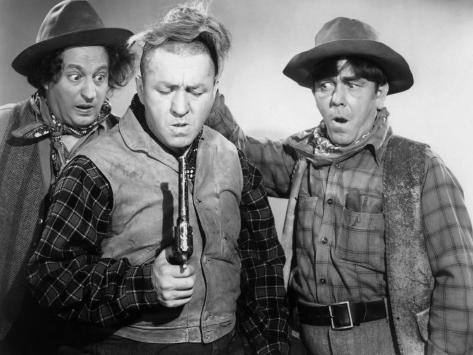
The three local fishermen who crowd around the dead shark's gaping maw have the appearance of a knockabout comedy act. There's the bulky curly-haired one in the camouflage jacket with the whiny voice, the plump wise-cracking one with the mustard-coloured pork pie hat, yellow shirt and blood-stained light blue jacket, and the narrow-eyed creepy-looking thin one dressed in grey. Creepy Guy taps the snout of the dead fish with a pen and wrongly calls it a mako (which he also mispronounces, shortening the vowel and putting the stress on the second syllable) whilst Pork Pie Hat peers into the gullet and makes a joke that references both Seventies mainstream porn and politics. Hooper is revealed as a passer-by in yellow crosses the frame from right to left, and he identifies the catch as a tiger shark, whereupon Camouflage Jacket turns and stretches out the word what? in a high camp voice. As Mayor Vaughn approaches, shaking hands as if he were running for office, Hooper, who has begun propounding his bite radius theory, is hemmed in by the locals. Creepy Guy stands behind him and in a strangely unsettling moment blows on the back of his neck. In a movement that acts as a counterpoint to Vaughn's eager advance, Hooper retreats across the frame from right to left as the fishermen, not wanting to be robbed of their moment of glory, shout down any suggestion that they've caught the wrong shark. Hooper himself seems to be doing a bit of back-pedalling by finessing his words - 'I'm not saying it's not the shark. I am saying that it may not be the shark. It's just a slight difference in semantics, but I don't want to get beaten up for it.' Hooper will revert to more semantic distinctions in the following dinner table scene when he tells Ellen Brody 'They caught a shark. Not the shark.'
Subscribe to:
Posts (Atom)